
Stablecoins are increasingly being spent by card swipe.
Crypto payment cards have gone from a novelty to more than $750 million in monthly spend. These cards let people pay with crypto anywhere traditional card networks are accepted. Behind the scenes, the crypto — stablecoins, overwhelmingly — gets converted to local currency at the point of sale, so the payments look like any other card transactions to merchants.
Crypto cardholders don’t require a traditional bank account. Depending on the program, users either deposit stablecoins with a card issuer, or hold them directly onchain through self-custody. Crypto cards expand people’s access to U.S. dollar accounts globally, and they offer a convenient way for stablecoin holders to transact.
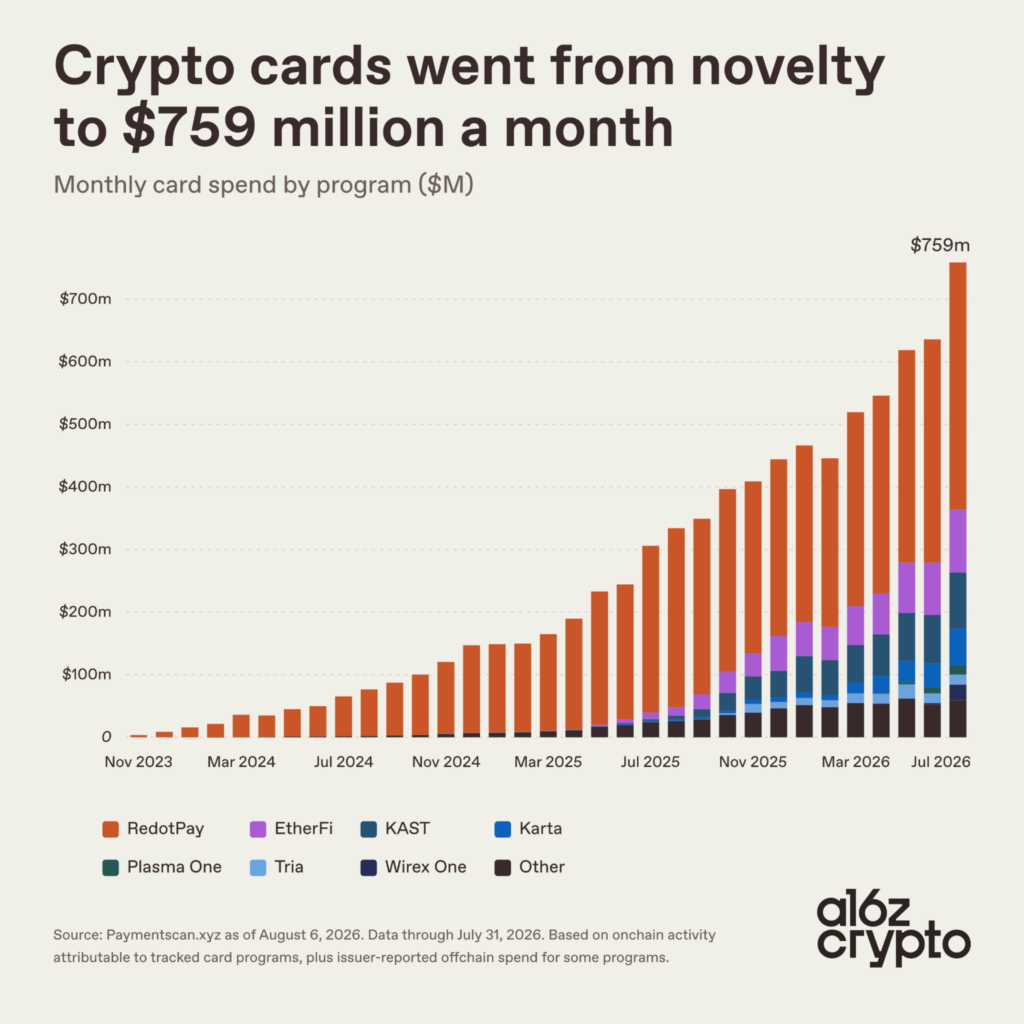
Monthly crypto payment card volume reached $759 million in July, up (roughly 2.5x) from $306 million a year earlier — and up from less than $1 million when tracking began in Oct. 2023. These figures reflect onchain activity attributable to card programs tracked by Paymentscan. (For RedotPay, the largest program by volume, spending is self-reported by the issuer rather than observed onchain.)
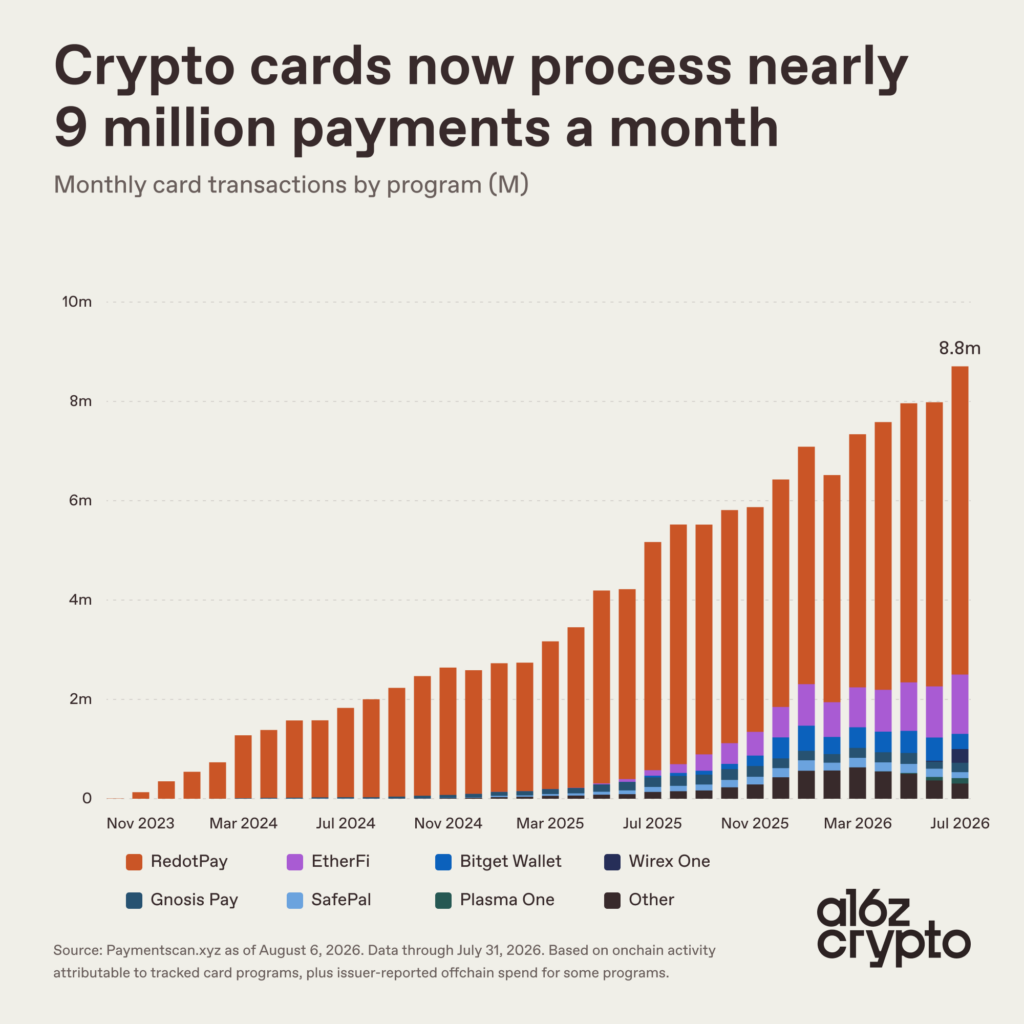
Growth in the number of purchases made with crypto payment cards is trending similarly to the growth in crypto card volume. Nearly 9 million purchases were made using crypto payment cards during July, up from about 5.2 million a year ago.
That puts the average amount spent per transaction at around $86.
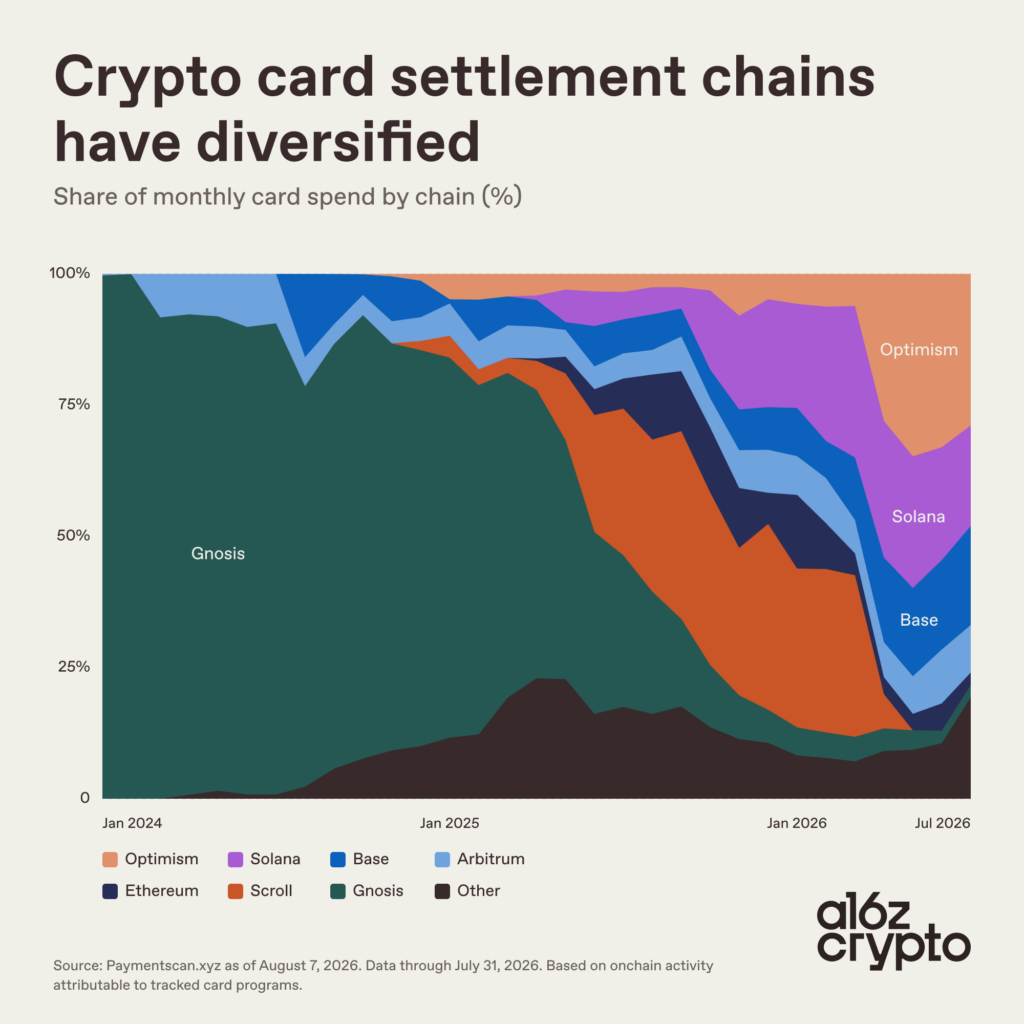
In early 2024, crypto card spending was concentrated in a single chain: Gnosis, home of Gnosis Pay (the first Visa card connected directly to a self-custodial wallet). As new card programs have launched, the number of card settlement chains has expanded.
As of July, Optimism carries about 29% of crypto card spend volume, Solana about 19%, and Base about 19%, according to Paymentscan. Gnosis has dropped to about 2%.
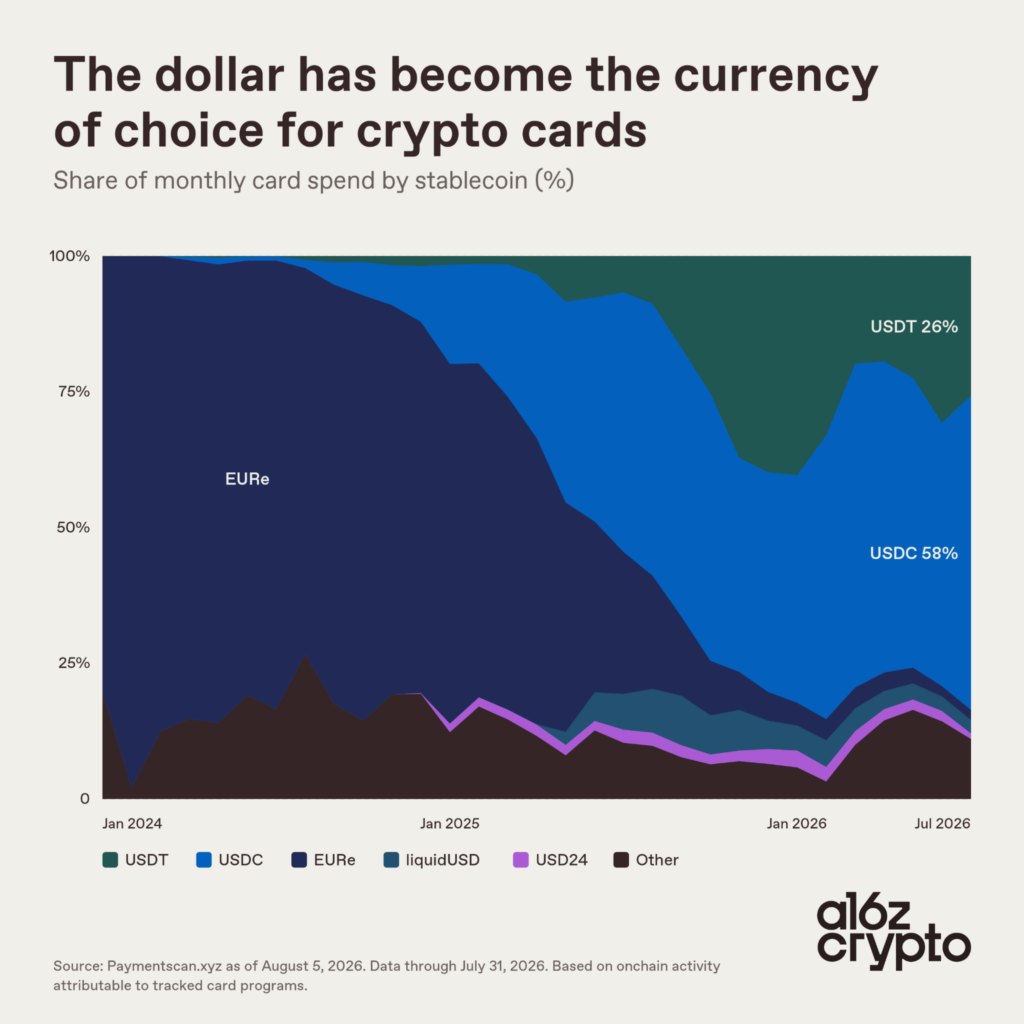
Euro-backed stablecoins once dominated spending: In early 2024, around 88% of crypto card volume settled in EURe, much of it on Gnosis. As of July, EURe’s share has fallen to about 2%.
Dollar-backed stablecoins have since taken the lead. USDC handles about 58% of card spending and USDT about 26%, up from roughly 48% and 7% a year ago, respectively. Crypto payment card spending now happens overwhelmingly in digital dollars.
Crypto payment cards remain a small market next to traditional card networks, which process trillions of dollars per month.
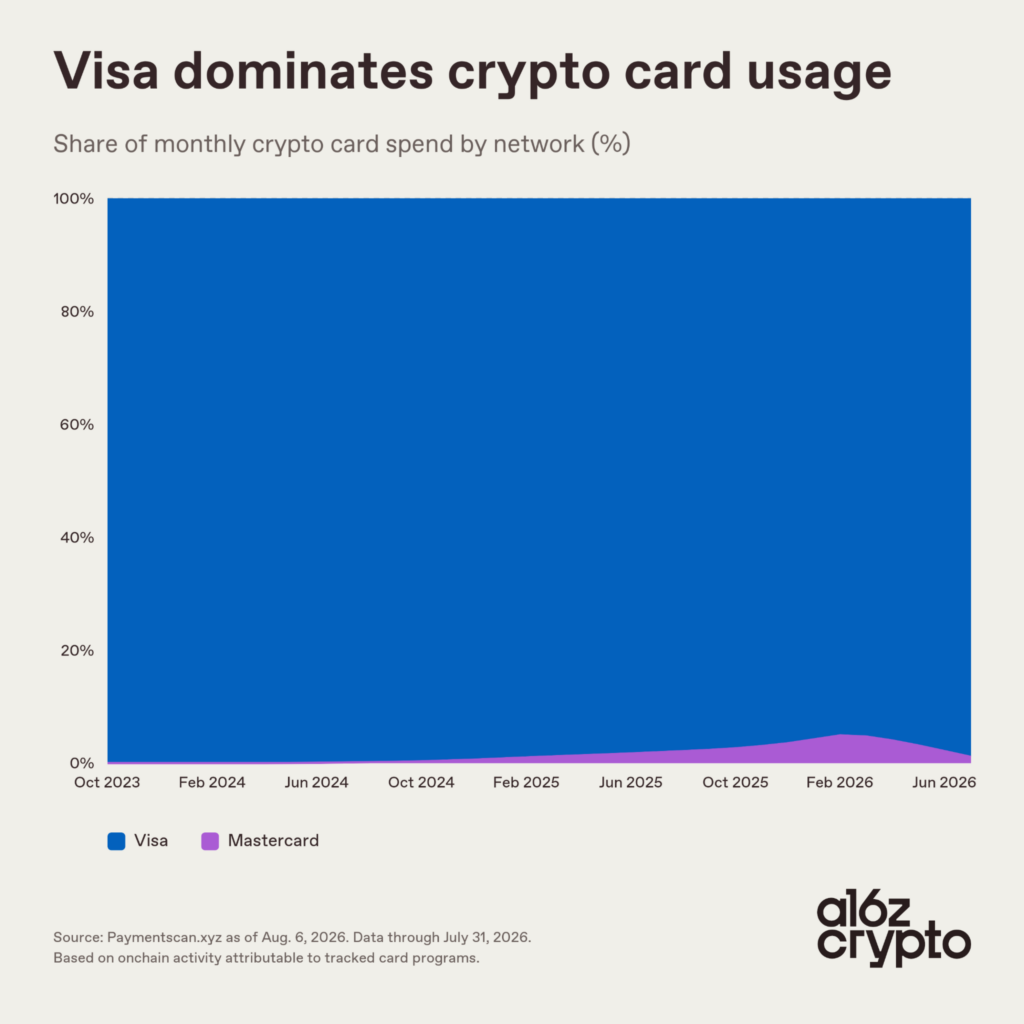
But the trend is growing as stablecoins make greater inroads into the global financial system, including by piggybacking on existing major card network rails. For the tracked programs, this is happening almost entirely through Visa.
Crypto payment cards are one piece of a broader crypto acceleration post-GENIUS, which we’ve been charting here. That includes the rapid adoption of stablecoins and tokenized assets.
***
Robert Hackett is features editor and head of special projects at a16z crypto.
Ryan Holloway is a data consultant.
***
This article was translated into Korean by Token Post, available here.
The views expressed here are those of the individual AH Capital Management, L.L.C. (“a16z”) personnel quoted and are not the views of a16z or its affiliates. Certain information contained in here has been obtained from third-party sources, including from portfolio companies of funds managed by a16z. While taken from sources believed to be reliable, a16z has not independently verified such information and makes no representations about the current or enduring accuracy of the information or its appropriateness for a given situation. In addition, this content may include third-party advertisements; a16z has not reviewed such advertisements and does not endorse any advertising content contained therein.
This content is provided for informational purposes only, and should not be relied upon as legal, business, investment, or tax advice. You should consult your own advisers as to those matters. References to any securities or digital assets are for illustrative purposes only, and do not constitute an investment recommendation or offer to provide investment advisory services. Furthermore, this content is not directed at nor intended for use by any investors or prospective investors, and may not under any circumstances be relied upon when making a decision to invest in any fund managed by a16z. (An offering to invest in an a16z fund will be made only by the private placement memorandum, subscription agreement, and other relevant documentation of any such fund and should be read in their entirety.) Any investments or portfolio companies mentioned, referred to, or described are not representative of all investments in vehicles managed by a16z, and there can be no assurance that the investments will be profitable or that other investments made in the future will have similar characteristics or results. A list of investments made by funds managed by Andreessen Horowitz (excluding investments for which the issuer has not provided permission for a16z to disclose publicly as well as unannounced investments in publicly traded digital assets) is available at https://a16z.com/investments/.
Charts and graphs provided within are for informational purposes solely and should not be relied upon when making any investment decision. Past performance is not indicative of future results. The content speaks only as of the date indicated. Any projections, estimates, forecasts, targets, prospects, and/or opinions expressed in these materials are subject to change without notice and may differ or be contrary to opinions expressed by others. Please see https://a16z.com/disclosures for additional important information.