
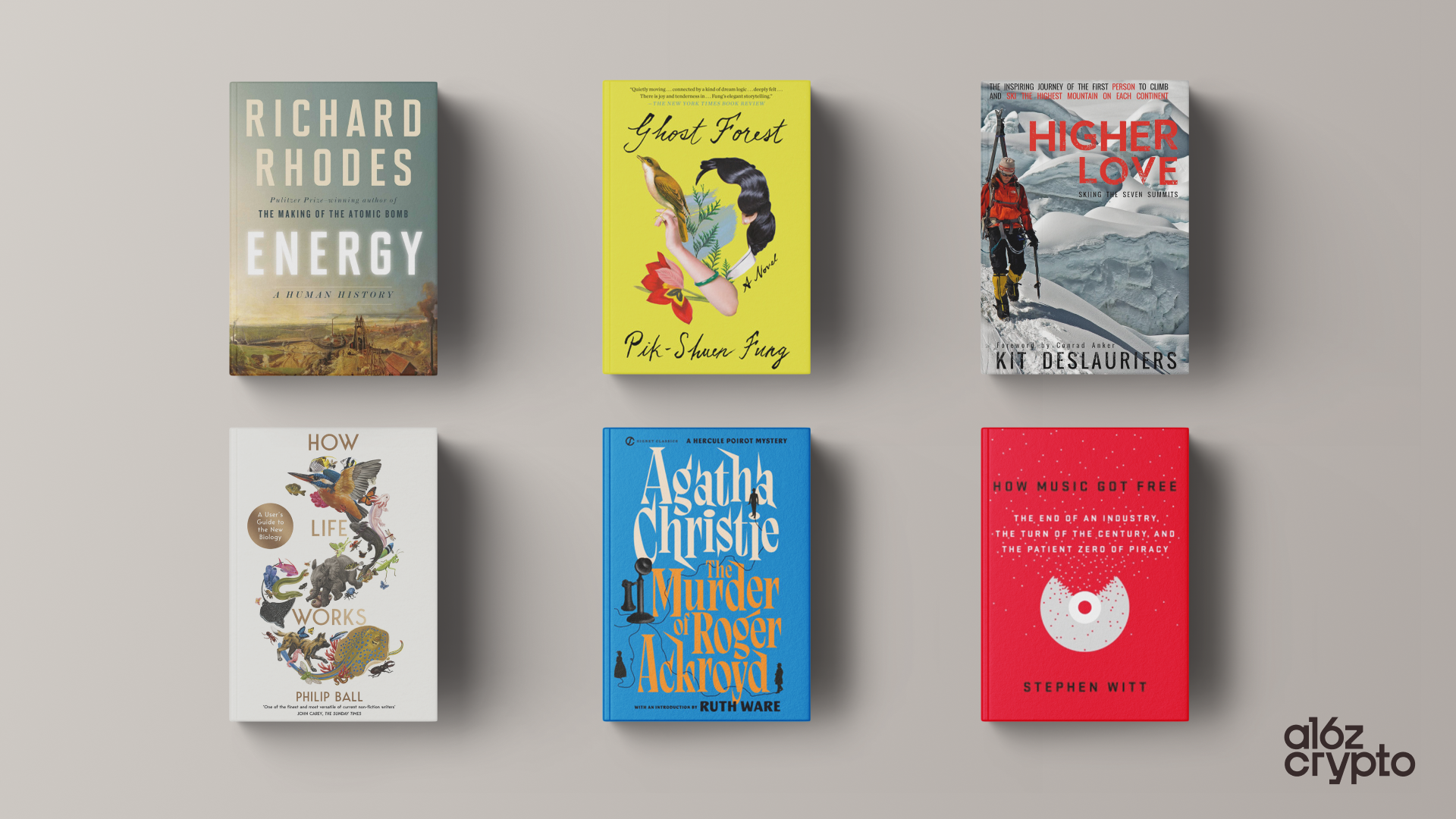
Here are a few of the books the a16z crypto team is reading and recommending this summer, from mountaineering memoirs and market histories to sci-fi, children’s books, and epistolary novels. Our picks also cover the seismic shifts in energy, manufacturing, biology, and technology that forced reinvention throughout history.
See more of our recommendations in reading lists from seasons past, including: summers 2025, 2024, 2023, 2022; and winters 2025, 2024, 2023, 2022.
Dan Boneh, research
Apple in China by Patrick McGee
How did China become so good at tech manufacturing? This book tells the story of how Apple spent over a decade and many resources to train firms in China to build Apple products, with stringent requirements and high precision. Along the way it tells the history of many Apple products and how they came to be. It is an interesting story of how we ended up where we are.
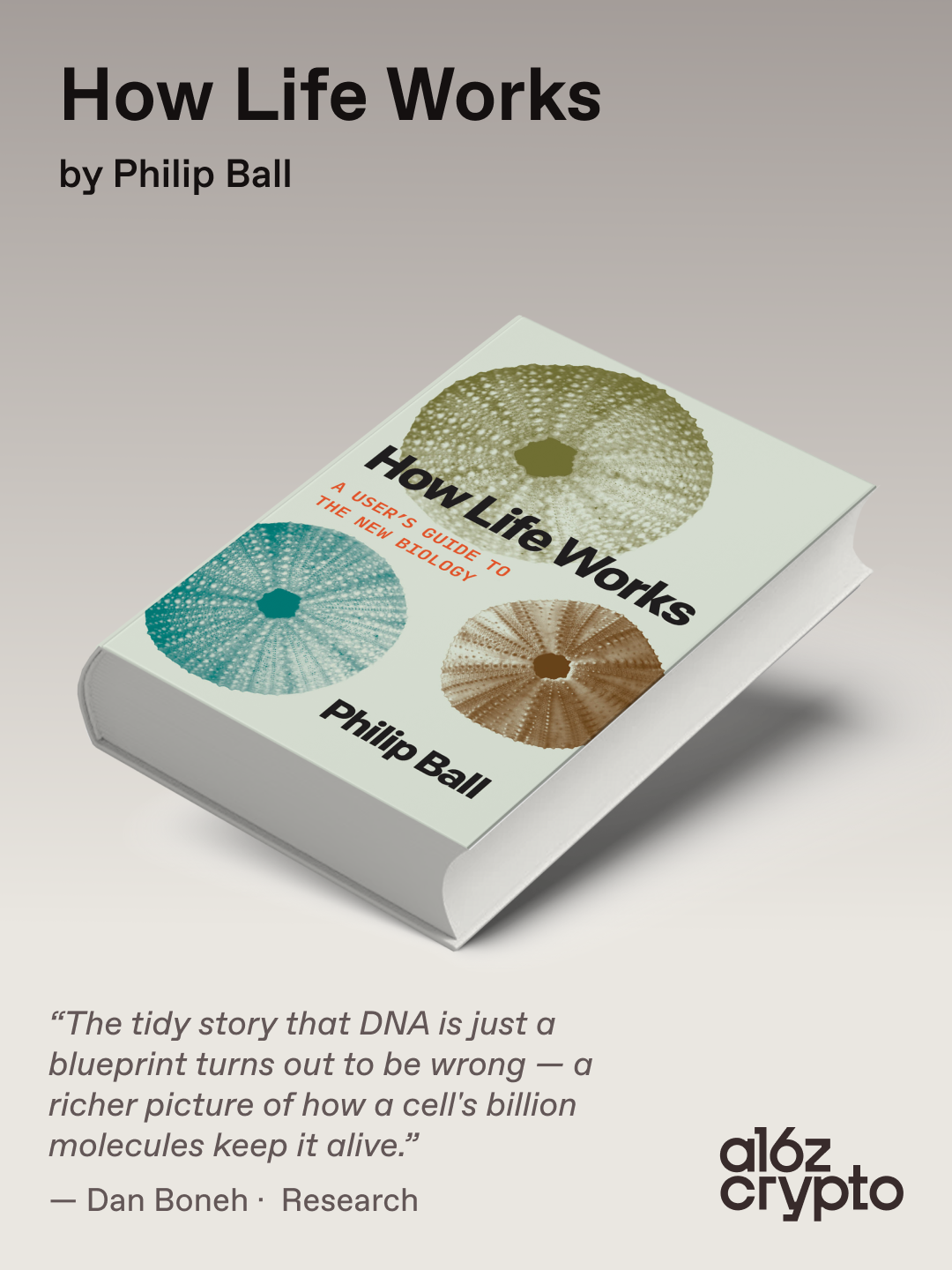
How Life Works by Philip Ball
We all learn in basic biology that the cell’s DNA is a blueprint for life: genes are copied into mRNA, the mRNA is sent to the ribosomes, and the ribosomes make proteins that drive the cell. It is a simple story that is appealing to engineers. This book explains that the story of life is way more complicated, and in some sense, the story we are taught is wrong. The book gives a more accurate, yet still incomplete, picture as to how the billion molecules in a single cell interact to regulate the cell and keep it alive.
Conner Lyons Brown, tech ops
We Few: U.S. Special Forces in Vietnam by Nick Brokhausen
Brokhausen’s memoir of MACV-SOG, the unit that ran the most dangerous missions of the Vietnam War behind enemy lines in Laos and Cambodia, is the rawest portrait of high-performing operators I’ve read. What stays with you is the psychology of doing something unprecedented and lethal, the macabre humor and resilience it takes to keep walking into the jungle knowing each step might be the last. For anyone who works in adversarial, high-stakes environments, it’s a bracing look at what real edge cases demand.
Leisure: The Basis of Culture by Josef Pieper
Pieper wrote this in 1948, but it reads like it was written for the age of AI. He diagnoses the two roads most traveled by any professional: the total world of work, where a person’s worth collapses into output, and a hollow pursuit of pleasure with no center. Pieper refuses both. Leisure, he argues, is not idleness or time off but a contemplative, receptive stance toward reality, the stillness to actually perceive the world rather than just operate on it. As AI absorbs more of the doing, the open question becomes what the doing was ever for, and Pieper’s answer, that the highest human activities are the ones done for their own sake rather than for compensation, lands harder now than when he wrote it.
Drew Coffman, editorial
Antkind by Charlie Kaufman
Narcissistic, recursive, and deeply in love with its own absurdity (complimentary). The whole book is a 700(!!)-page bit that never breaks character. Big Charlie Kaufman energy.
Apple: The First 50 Years by David Pogue
An exhaustive march through fifty years of Apple’s history. Pogue has been chronicling Apple for so long (starting at Macworld in the 80s) that he’s one of maybe three people alive who’d get this kind of access, which is what makes it great. Dropped weeks before Tim Cook announced his exit, this text works as a bookend, catching Apple right as one chapter closes and another cracks open.
Augustus by John Williams
Everyone always talks about Stoner, but not enough people talk about John Williams’s other incredible work: Augustus. Told in the form of an epistolary, this portrait of Augustus as an idealist and pragmatist feels deeply relevant.
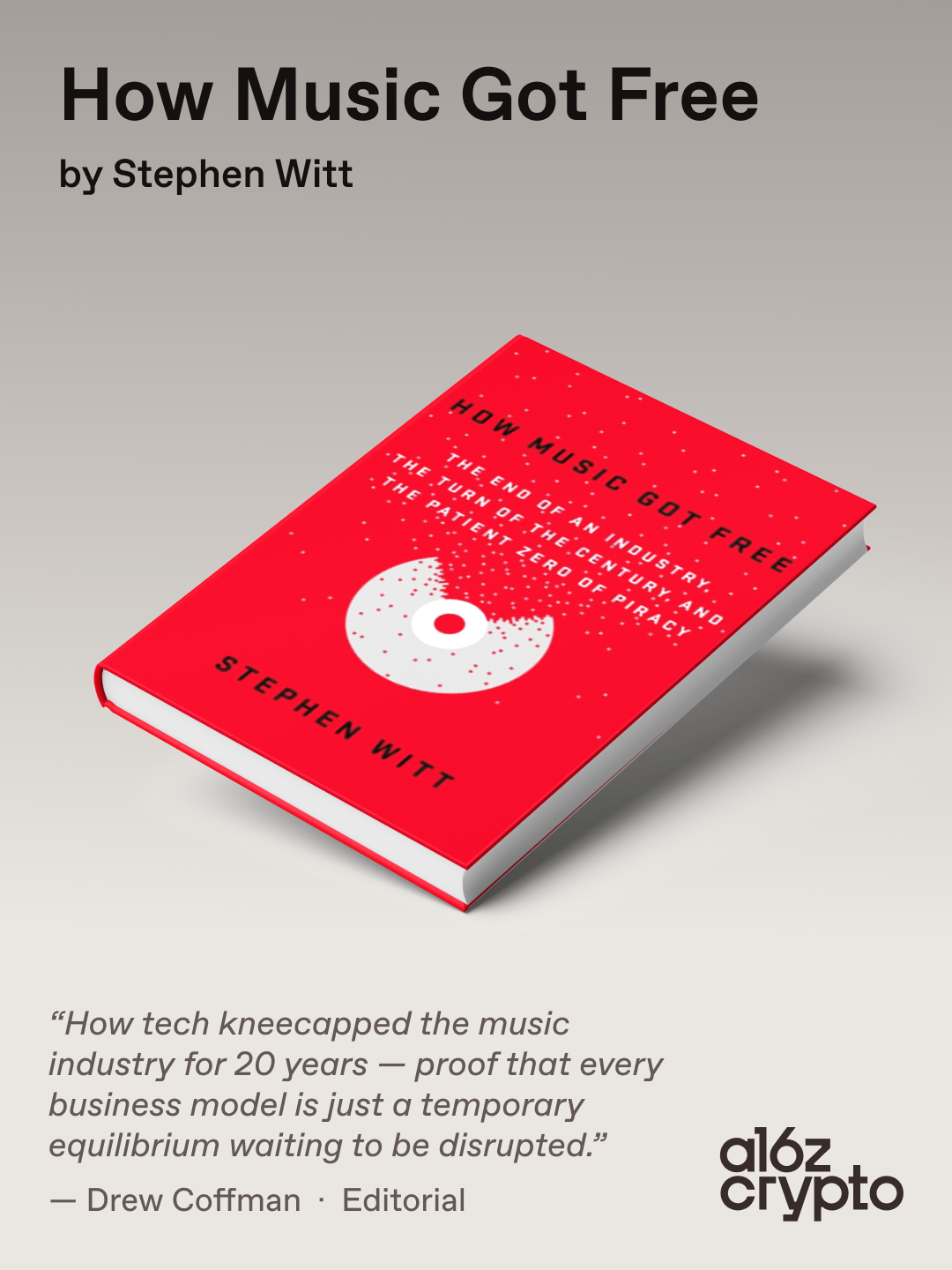
How Music Got Free by Stephen Witt
Did you know that one CD manufacturing plant employee leaked thousands of albums before release, becoming an inadvertent kingpin of the warez scene? This book chronicles how technology repeatedly kneecapped the music industry over 20 years: mp3s begat piracy which decimated CDs, iTunes changed the album, YouTube opened up a new listening stream, VEVO made the music industry money again, and then streaming cannibalized everything. Reading this book makes it clearer to see the music industry’s current model as just another temporary equilibrium waiting to be disrupted. A great example of how tech obliterates business models and forces reinvention.
Robert Hackett, editorial
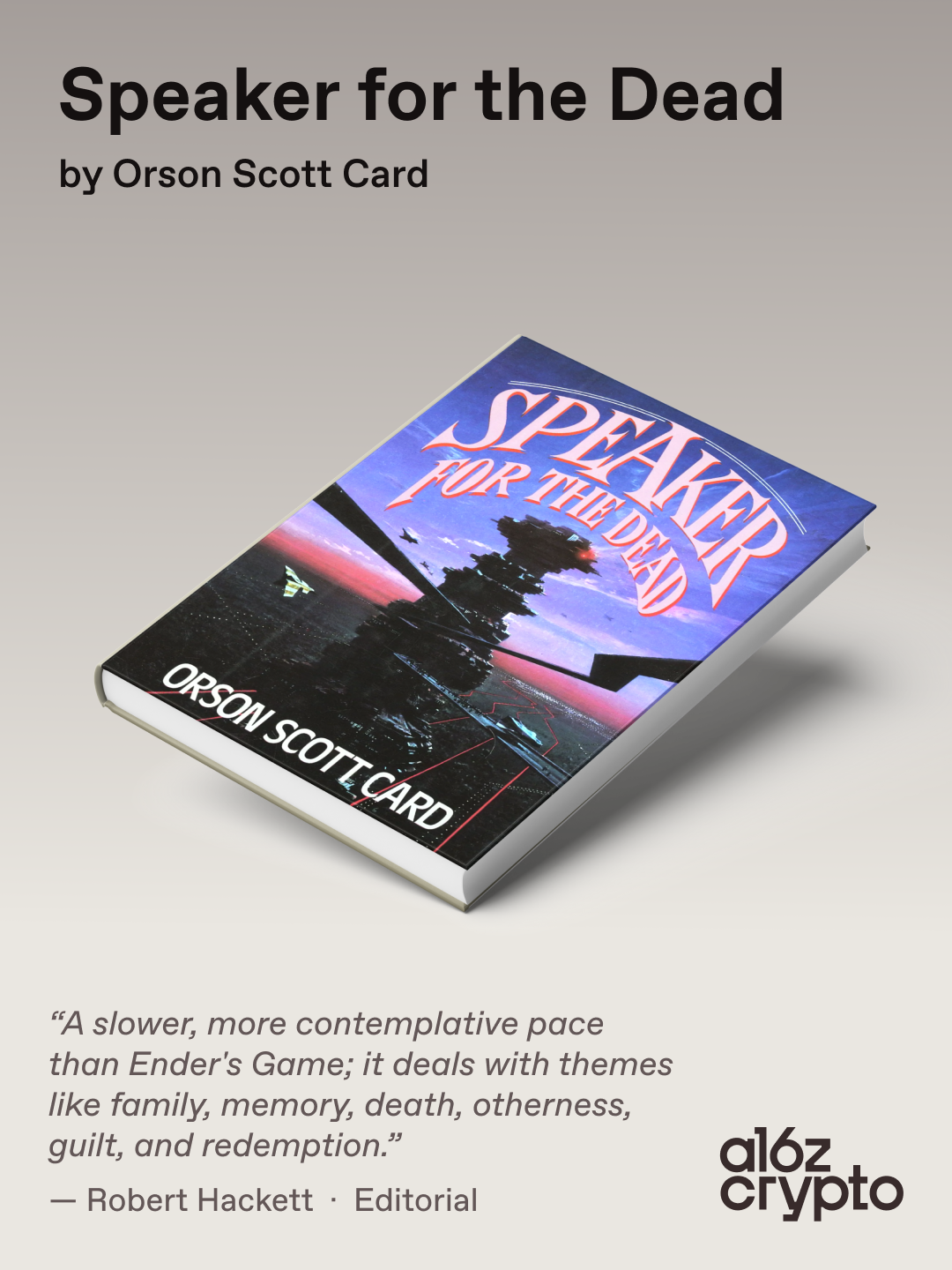
Speaker for the Dead by Orson Scott Card
When I was younger, I tried reading Speaker for the Dead many times. It was tucked into the back half of my well-worn copy of Ender’s Game, which I had devoured. I could never get past the first chapter.
Speaker was unlike everything I loved about the Ender saga. No pressure cooker for child prodigies. No eerie, video game-mediated, psychoanalytic dream sequences. No fate of humanity hanging in the balance. And where the Formics were terrifyingly badass, these aliens were…“piggies”? C’mon.
I’ve always felt a kinship with Ender, as I suspect most kids who become engrossed in the story do. (By some cosmic coincidence, I was surprised to discover that I’m the same age as he is in Speaker, just as I was his age when I first read Ender’s Game decades ago.) Then as now, it has always fascinated me that Card considered Speaker to be the book he had really set out to write, and that he rushed the first book merely to tee it up. How could that possibly be the case?
I think I understand better now. Speaker lacks the narrative perfection — and kinetic energy — of its prequel, but I can appreciate its slower, contemplative pace far more now that I’m older. It deals with themes like family, memory, death, otherness, forgiveness, guilt, and redemption — subjects I cared, apparently, less about in my youth. I still find Speaker challenging to love, but I respect the way it complicates the story I loved so much growing up. I still prefer Ender’s Game, but I have a much better sense of why Card saw Speaker as his true purpose.
Fahrenheit-182: A Memoir by Mark Hoppus
Punk rejects mass culture. Pop is mass culture. So how does a pop-punk band like Blink happen?
In his memoir, bassist and only constant member Mark Hoppus recounts playing a show in Bologna where the crowd hurled rocks and bottles at them. A year earlier, Blink had released a viral video mocking boy bands, and had become so successful that some audiences — a contingent of hostile Italian metalheads, in this case — could not tell the parody from the thing being parodied. (Or didn’t care to.) As Hoppus puts it: “They didn’t want some bullshit American pop act fucking up their heavy show.”
I love this anecdote — not just because it’s darkly comic (guitarist Tom DeLonge reportedly swore off pasta bolognese afterward) and boy bands are dumb, but because it illuminates one of modernity’s supreme ironies: What happens when countercultures go mainstream. A similar arc can be traced across jazz, abstract art, hip-hop, skateboarding, streetwear, open source software, and, relevantly for this audience, crypto.
Fahrenheit-182 is also a founder story. Hoppus and DeLonge are a volatile creative duo — like Lennon and McCartney with fart jokes. The same forces that allowed them to pump out hits eventually tore them apart. Fortunately, unlike most founder breakups, this one had a reunion tour. I caught them at Madison Square Garden a few years ago and it was a glorious, stupid, perfect blast of nostalgia.
So is the book.
Andy Hall, research
The Education of Henry Adams by Henry Adams
An extraordinary reflection of living through a period of intense technological change. Adams reflects on how the educational system failed to anticipate the radical transformation he experienced, and describes where he learned life’s true lessons. A classic and timeless book that’s perfect for today’s moment.
A World Beneath the Sands: Adventurers and Archaeologists in the Golden Age of Egyptology by Toby Wilkinson
A sweeping exploration of the history of Egyptology and how humanity deciphered hieroglyphics, developed the science of archaeology, and competed for prestige through scientific discovery. You’ll find interesting and strange connections to today’s tech race.
Liz Harkavy, deal
The Will of the Many by James Islington
I loved how The Will of the Many blends an elite academy setting, Roman-inspired politics, and a genuinely propulsive mystery. The book is smart and immersive without feeling slow and it has novel world-building.
Maggie Hsu, go-to-market
Nyla the NFT by Maggie Hsu and Nyla Hayes
Most of the crypto books for kids are basic glossaries. I wanted to write something educational that also had an engaging storyline. Nyla the NFT teaches basic crypto concepts inspired by the story of The Wizard of Oz. A group of NFTs venture down the “yellow blockchain road” and learn about self-acceptance along the way. My co-author Nyla Hayes is a talented multidisciplinary teen artist who also did all the illustrations.
Stablecoins for Babies by Edward Woodford
Stablecoins for Babies is exactly what it sounds like — a board book about stablecoins. It makes for the perfect baby shower gift (along with some USDC).
Scott Duke Kominers, research
Moral Economics: From Prostitution to Organ Sales, What Controversial Transactions Reveal About How Markets Work by Alvin E. Roth
My doctoral advisor Al Roth has been thinking for decades about “repugnance” – why some people prefer that some markets should not exist. In Moral Economics, he tackles the motivation for these prohibitions, and the trade-offs they force, head-on. And he explores in particular how such (non-)market norms emerge and sometimes later collapse (limitations on alcohol, drugs, and – in a completely different category – same-sex marriage have all been relaxed in recent years), and what this means for making markets in the future.
The Proof in the Code: How a Truth Machine Is Transforming Math and AI by Kevin Hartnett
I’ve recently become fascinated by the potential of formal verification to refine our understanding of math and economic theory.
The basic design paradigm is simple: proofs written in a machine-checkable language, where “compiling” means that every logical step is completely sound. Lean – first launched by Leonardo de Moura in 2013 and now chronicled in Hartnett’s book – is the leading such “proof assistant” these days. It spawned a massive project to formalize mathematics from the ground up, and has crossed over to cryptography and software security (and some of my collaborators and I have been bringing it to economics).
This tech has taken on particular importance in recent years, as it is a perfect complement to generative AI. Lean at once turns proof logic into a machine language that AI models can reason in more easily, and provides a trusted system to verify (or reject) conclusions when AI models try to “prove” in ways that are difficult for humans to understand.
The Man Who Saw Seconds by Alexander Boldizar
A fascinating speculative-fiction framework: what happens if one can see just a tiny bit into the future, and pick the preferred passage through time? While you might hope that you could just spend those precious seconds winning at casinos, such a metaphysical gift – at least seen through a certain lens – might put pressure on the very foundations of civil society.
Scaling People: Tactics for Management and Company Building by Claire Hughes Johnson
My friend and co-author Jesse Shapiro recently recommended this book to me and it’s fantastic: easily the best book I’ve ever read on both (1) managing people and (2) managing people’s interactions with you. Hughes Johnson, who served as COO at Stripe through their period of massive growth, gives a vivid and very, very practicable guide to understanding individuals’ and teams’ motivations and operating modes. The book comes with detailed principles and strategies for everything from hiring and onboarding to day-to-day management, communication, evaluation, and feedback. But the biggest payoff is the way the book trains awareness and recognition of people as they are, and how to build on that to help them maximize themselves.
Introduction to Quantitative Economics by Jesse M. Shapiro
And speaking of Jesse Shapiro, he has a new book out this spring that teaches his special brand of theory-grounded reasoning about data in economics. Shapiro is one of the most brilliant pedagogues in the field, and the book translates his crystal-clear thinking into a series of illustrations and exercises that take you from classic first-principles price theory to the empirical frontier in just 64 pages. It’s perfect for a self-study course, and appropriate for both newcomers and experts alike.
The Art and Craft of Problem Solving by Paul Zeitz
While I’ve been “Lean”-ing into formal mathematics this spring, I’ve also been revisiting classic works to fine-tune my mathematical thinking and problem-solving. And there’s no better book for that than Paul Zeitz’s magnum opus, now in its third(!) edition.
The Murder of Roger Ackroyd by Agatha Christie
This year marks the 100th anniversary of one of the most brilliant and category-defining mystery novels of all time.
Christie’s detective Poirot has retired to the countryside (to grow vegetable marrows – I’ve always liked this detail). But he quickly gets wrapped up in investigating the stabbing of the eponymous Ackroyd, as narrated by village physician Dr. Sheppard – who plays a sort of “Watson” throughout. To hear Sheppard tell it, with all the murderer’s misdirection and so many false leads, this might almost have been one of Poirot’s greatest failures. But in fact, it became perhaps Christie’s greatest success.
She Walks at Night by Seishi Yokomizo & The Clock House Murders by Yukito Ayatsuji
While you’re in the mystery mode, you absolutely must read this summer’s newest honkaku translations from Pushkin Vertigo.
She Walks at Night is the perfect follow-up to Ackroyd: a tale of family dysfunction, jealous relations, and not one but two hunchbacks (or possibly three?), who find themselves tied up in a crisscrossing web of their own weaving. The story as told is like a cross between a stage play and a waking dream – you’re never quite sure who’s who, or who’s playing which role. Despite literally every clue being handed to the reader, there’s a sense of almost sleepwalking into the final resolution.
The Clock House Murders, meanwhile, unfolds in parallel both inside and outside the mysterious Clock House, where 108 timepieces of all shapes and sizes pace the action day and night. Timing distortion is a classic mystery trope – the stopped clock, the wristwatch set back an hour, and the like – and here you naturally expect that similar games are at play. Yet the author demolishes each such idea almost as soon as it occurs, leaving the reader to wonder whether all the clocks are somehow a meta-ruse just to redirect attention away from what’s really going on. I couldn’t put this one down – time seemed to speed up as the story raced towards its conclusion, and I found myself turning the pages faster and faster.
Kim Milosevich, marketing
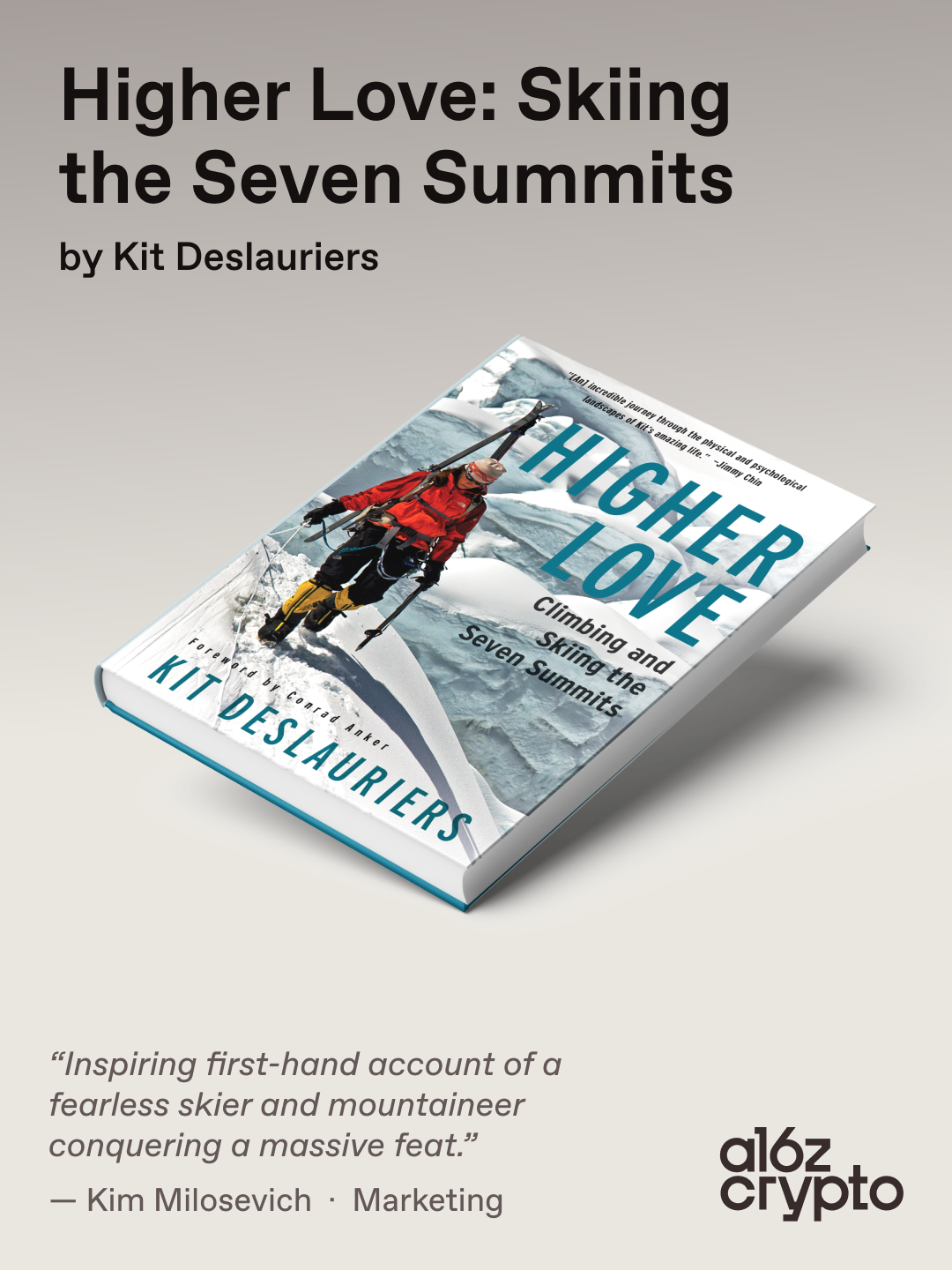
Higher Love: Climbing and Skiing the Seven Summits by Kit DesLauriers
Inspiring first-hand account of a fearless skier and mountaineer conquering a massive feat — climbing and skiing the world’s seven highest peaks. It gives a peek into what drives her to complete this impressive feat but also the very real fears and circumstances she has to overcome. The book also introduces you to a colorful cast of characters that make up the climbing community around the world, who band together to help Kit reach her dream.
Hoang Nguyen, marketing
Think You’ll Be Happy: Moving Through Grief with Grit, Grace, and Gratitude by Nicole Avant
A book about grief, purpose, and the legacy a mother leaves behind — woven with stories from music, culture, and politics.
SungMo Park, go-to-market
The Super Gap (초격차, or Cho-gyeok-cha) by Oh-Hyun Kwon
This book is written by the former chairman of Samsung Electronics, who led the company to become the number one semiconductor company globally. “The Super Gap” means a gap so wide that competitors cannot even think about challenging you. Based on his 33 years at Samsung Electronics, he distills his leadership experience into four pillars: leader, organization, strategy, and talent. The author explains that this “Super Gap” applies not only to technology but also to systems, culture, people, and organization. It’s especially compelling because these insights come from someone who experienced both success and failure firsthand, and who ultimately walked away at the peak to practice the “sustainability” he preaches.
Robbie Petersen, deal
I See Satan Fall Like Lightning by René Girard
One of the most thought-provoking frameworks that reveals why we desire the things we desire and what this implies for how society is organized. If you love philosophy, anthropology, history and theology – great read.
Jason Rosenthal, operations
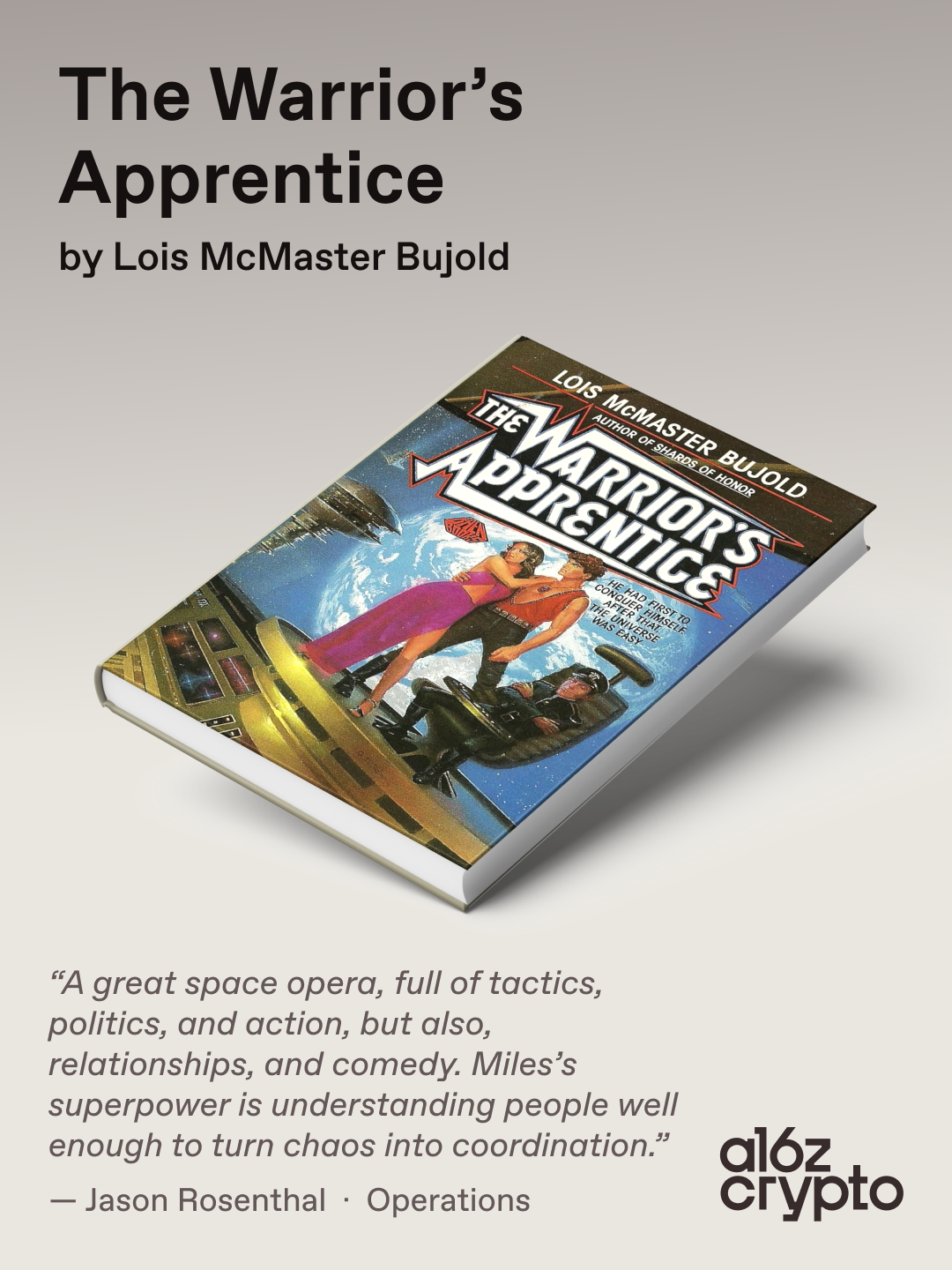
The Warrior’s Apprentice by Lois McMaster Bujold
Lois McMaster Bujold’s The Warrior’s Apprentice follows Miles Vorkosigan, a brilliant, physically fragile young noble who fails his military entrance exam and then, through bluff, charisma, and improvisation, accidentally assembles a mercenary fleet.
It’s a great space opera, full of tactics, politics, and action, but what makes it memorable is how much it leans into character development, relationships, and comedy. Miles’s superpower is not technology or force; it’s his understanding people well enough to turn chaos into coordination.
Aiden Slavin, policy
Energy by Richard Rhodes
Rhodes is the author of one of my favorite series of all time, the four-volume nuclear history that begins with the Pulitzer-winning The Making of the Atomic Bomb, plus several novels that are very good, if less heralded. Energy is his five-century study of how humanity moved from wood to coal to oil to electricity and on toward nuclear and renewables, told the way Rhodes tells everything: through people, and through false starts, bad bets, and inventors who accidentally solved the right problem. Reading his work, it’s hard not to notice how often progress came down to scaling capacity as much as fundamental breakthroughs, exactly the question the AI buildout is now forcing, as compute demand revives interest in nuclear and reshapes grids. The constraint on this next computing era may be joules rather than algorithms, a challenge we’ve navigated before.
Kira Song, finance
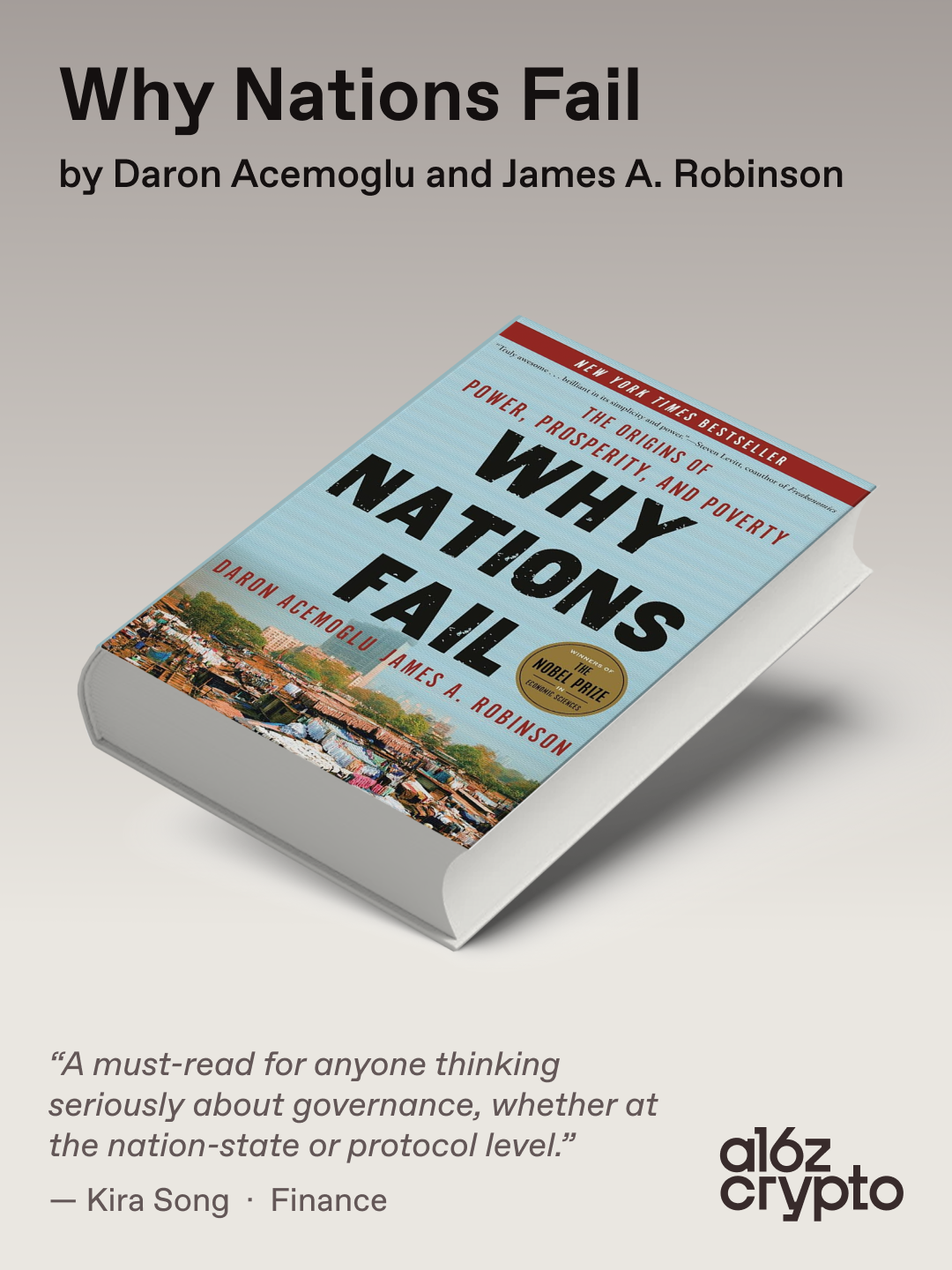
Why Nations Fail by Daron Acemoglu and James A. Robinson
Acemoglu and Robinson’s central thesis, that inclusive institutions drive prosperity while extractive ones cause stagnation, maps surprisingly well onto crypto. Decentralized protocols are essentially an attempt to hard-code inclusive institutions: open access, no gatekeepers, rules enforced by code rather than by whoever’s in power. The book is a great lens for thinking about why certain blockchain ecosystems thrive while others get captured by insiders. A must-read for anyone thinking seriously about governance, whether at the nation-state or protocol level.
Tim Sullivan, editorial
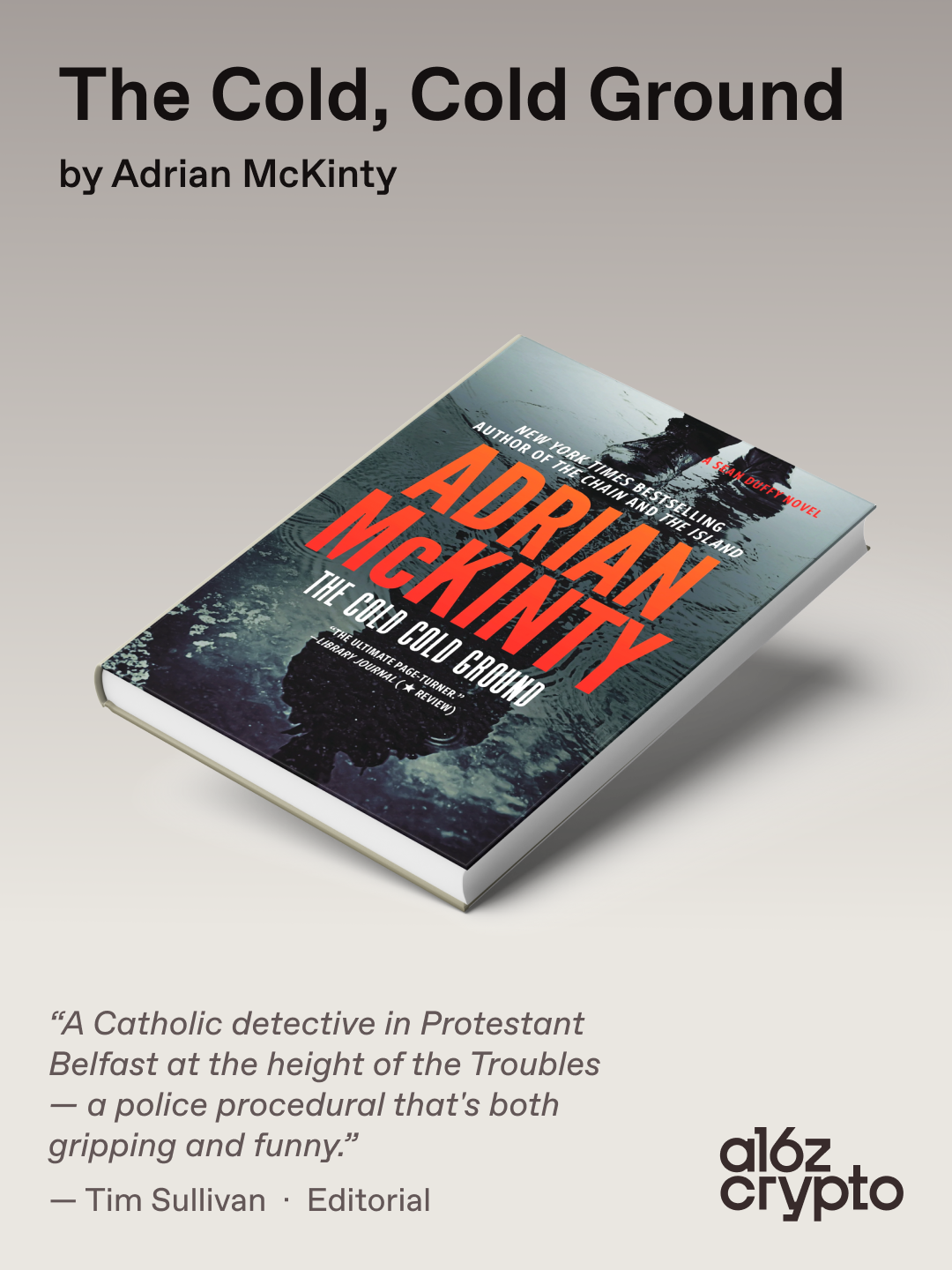
The Cold Cold Ground by Adrian McKinty
What do you do if you’re a Catholic copper in Protestant Belfast at the height of The Troubles? You check under your car for a bomb every morning before going to work. Adrian McKinty’s The Cold Cold Ground combines the kind of detective story I like with a vividly realized setting. Belfast in 1981 is a place where every institution is contested and every identity carries consequences. Sean Duffy solves crimes while navigating that landscape with intelligence, wit, and a healthy appreciation for the possibility that someone may be trying to kill him. The result is both gripping and funny — just the kind of police procedural I love.
An Engine, Not a Camera: How Financial Models Shape Markets by Donald MacKenzie
Sociologist Donald MacKenzie’s An Engine, Not a Camera is nominally a book about financial economics, but its real subject is more provocative: What happens when theories stop describing the world and start changing it? MacKenzie traces how academic models of markets escaped the university and became embedded in the markets themselves. First published in 2006, it remains relevant today in a number of contexts — not least because of the recent interest from TradFi in crypto. But I wanted to read it again because of the book I’m working on with colleague Robert Hackett, about how computer science theories acted on the world.
Thrown by Kerry Howley
In this work of literary non-fiction (maybe?), the narrator, Kerry Howley (who may be the same person as the author, but may not be) follows a pair of mixed martial artists around Iowa (where author Howley had done her MFA). Both Howleys explore obsession, uncertainty, and the search for meaning with unusual intelligence and empathy — and with a prose style that both surprises and delights. It’s nominally a book about fighting, but it’s really a book about commitment (and maybe a book about a book about fighting).
Ertem Nusret Tas, research
Sátántangó by László Krasznahorkai
This is one of the unique books I liked mainly for its narrative style, characterized by lengthy sentences and complex paragraphs. Very Kafkaesque undertones as well.
Benjamin Wu, talent
A Man for All Markets: From Las Vegas to Wall Street, How I Beat the Dealer and the Market by Edward O. Thorp
Growing up, I was obsessed with the movie 21 and the idea that you could actually use math to beat the house. This book is the autobiography of the man who essentially started it all. Edward Thorp went on to apply those same principles to Wall Street and became the father of quantitative investing. It’s an incredible story about using pure logic to disrupt rigged, legacy systems, which completely captures the exact same builder mindset we see in crypto today.
Michael Zhu, engineering
The Carrier Bag Theory of Fiction by Ursula K. Le Guin
The Carrier Bag Theory (coined by Elizabeth Fisher) centers the container, or bag, as the original human technology — a tool for gatherers to carry food and other items — in contrast to the prevailing narrative that centers the weapon (rock used as bludgeon). In Le Guin’s essay, she applies this lens to narrative fiction, framing the novel as a container of characters and stories. Shape rotator that I am, I instead found parallels in math and software: The foundational object underlying all mathematics is the set, and what is a set if not a container, a bag of elements? And in software — beyond the obvious syntactic parallels (see, e.g., Docker), it is the nesting-doll containment (also known as “abstraction”) of complexity that makes this whole enterprise possible. There are bags everywhere for those with the eyes to see.
Stephanie Zinn, editorial
Catherine the Great & Potemkin: The Imperial Love Affair by Simon Sebag Montefiore
Just your standard romance but with more urban planning and foreign policy memos. Catherine the Great & Potemkin is part imperial history, part power-couple biography, and part extremely high-stakes situationship. The story of this Antony-and-Cleopatra-level romantic and political partnership is told with all the drama and detail you’d hope.

Ghost Forest by Pik-Shuen Fung
A slim, soft and plainspoken piece of autofiction on loss, grief, and the complexity of parent/child relationships.
The narrator grows up in Canada, while her father stays behind in Hong Kong to keep working — so the relationship she’s mourning was mostly conducted across an ocean, in short visits and longer silences. The story of Fung’s loss is told in short vignettes with a lot of white space, which could read as gimmicky but somehow doesn’t.
As a bonus, the book has some lovely depictions of death rituals and mourning practices, particularly in the sections connected to Hong Kong and the family’s Chinese cultural background. It’s short enough to finish in one sitting, but sticks with you long after.
The views expressed here are those of the individual AH Capital Management, L.L.C. (“a16z”) personnel quoted and are not the views of a16z or its affiliates. Certain information contained in here has been obtained from third-party sources, including from portfolio companies of funds managed by a16z. While taken from sources believed to be reliable, a16z has not independently verified such information and makes no representations about the current or enduring accuracy of the information or its appropriateness for a given situation. In addition, this content may include third-party advertisements; a16z has not reviewed such advertisements and does not endorse any advertising content contained therein.
This content is provided for informational purposes only, and should not be relied upon as legal, business, investment, or tax advice. You should consult your own advisers as to those matters. References to any securities or digital assets are for illustrative purposes only, and do not constitute an investment recommendation or offer to provide investment advisory services. Furthermore, this content is not directed at nor intended for use by any investors or prospective investors, and may not under any circumstances be relied upon when making a decision to invest in any fund managed by a16z. (An offering to invest in an a16z fund will be made only by the private placement memorandum, subscription agreement, and other relevant documentation of any such fund and should be read in their entirety.) Any investments or portfolio companies mentioned, referred to, or described are not representative of all investments in vehicles managed by a16z, and there can be no assurance that the investments will be profitable or that other investments made in the future will have similar characteristics or results. A list of investments made by funds managed by Andreessen Horowitz (excluding investments for which the issuer has not provided permission for a16z to disclose publicly as well as unannounced investments in publicly traded digital assets) is available at https://a16z.com/investments/.
Charts and graphs provided within are for informational purposes solely and should not be relied upon when making any investment decision. Past performance is not indicative of future results. The content speaks only as of the date indicated. Any projections, estimates, forecasts, targets, prospects, and/or opinions expressed in these materials are subject to change without notice and may differ or be contrary to opinions expressed by others. Please see https://a16z.com/disclosures for additional important information.