
Here are a few of the books the a16z crypto team is reading and recommending this winter, from the history of industries like oil and AI to the history of books themselves — and from biographies and memoirs to thrillers and graphic novels. See more of our recommendations in reading lists from seasons past, including: summers 2025, 2024, 2023, 2022, 2019; and winters 2024, 2023, 2022, 2018, 2017, 2016.
This year, we’ve also included a few curated picks from our founders, covering sci-fi reads, market design, and more.
Sonal Chokshi, editorial
The Loneliness of Sonia and Sunny by Kiran Desai
I am not really into this genre anymore — not since its heyday of Salman Rushdie’s Midnight’s Children or Rohinton Mistry’s Such a Long Journey — so it says a lot that I really liked this book; it has more than just the usual tropes (although it does still have the tropes). But I devoured all ~650 pages in just days since couldn’t put it down! Desai’s book is so rich with detail, you are gripped both by the characters and by how is-she-able-to- capture all those descriptions?! It’s no wonder that Desai apparently took 20 years to write this novel since winning the Booker Prize for her first book in 2006 (then the youngest author to do so). This new book was also shortlisted for the Booker Prize, but that’s generally an anti-heuristic for me so I’m recommending this book despite all that.
Sonia and Sunny is partly a romance, mostly a family drama, set against the backdrop of immigrants’ and traveler’s experiences — but it’s really a deeply psychological novel, rich with observation about humans more universally: our ambitions, our desires, our yearnings, our learnings in relationships and as we move through the world. I highly recommend this book!
When the Going Was Good: An Editor’s Adventures During the Last Golden Age of Magazines by Graydon Carter
I deeply miss the Golden Age of magazines, and Vanity Fair was my favorite of this genre — along with Lucky, which thanks to Substack I finally feel like I’ve found again, since I follow all the editors I used to love now thankfully on there! (I followed Air Mail, too, until Carter left). So I am a superfan of Carter’s, although I did find his personally narrating this book a bit tough to follow initially; I know authors should read their own memoirs, but voice cadence, articulation, and inflection really matters these days.
Carter’s memoir was most interesting in the parts where he talked about his philosophies and approaches on magazines, and when he shared some fun inside details on Conde Nast (where I also once worked when at Wired). I especially devoured the details on topics like publishing cadence, specific articles and authors, and how big iconic events like the annual VF Oscar Party came about. When the book ended — and it ends with a delightful list of Carter’s “rules for living”, spanning everything from how to do table place cards to choosing friends who are FISK (funny, interesting, smart, and kind) — I actually cried. I was sad to lose the parasocial “friend” I’d followed for decades and across these pages, and was deeply sad about the end of an era for a medium that shaped our culture… and more inspired than ever to make my own.
Empire of the Elite: Inside Condé Nast, the Media Dynasty That Reshaped America by Michael Grynbaum
I immediately followed the above Carter memoir with this book, where the author compellingly reads the intro — but then is followed by a buttery-flat audio narrator that sounded like AI and that I found off-putting at first (guys, voice in audiobooks and technology for reading really matters!!) But the stories in this book, especially for a magazines lover, are very compellingly told through the real-life characters of Conde Nast founders and owners and stewards and editors and other makers.
Of course my favorite parts were about Vanity Fair, which in many ways was like a startup that was rebooted, pivoted, and eventually found its product-market fit in its high-low mix under Tina Brown. This book is really about the “inclusive exclusivity” that Conde Nast magazines provided in an age of aspiration and growing middle class; and of course, the key role not just of media funders, but of editors as curators (and sometimes creators) of culture. I know it’s popular to talk about the end of gatekeeping, which I think is a very good thing; but not so the end of curating, which we now need more than ever in an age of media slop.
Christian Crowley, go-to-market
Ra by qntm
I’m a big fan of all of qntm’s work, but Ra stands out to me because it treats the premise “what if magic were real?” with a rigor and modernity that feel genuinely fresh. It’s not fantasy; it’s sci-fi, and the story pushes that basic premise into deeper, tech-driven themes that make the world feel like a strange version of the future.
What really stuck with me is how character-driven it is. The truths of this world unfold through the perspectives of several memorable characters, and watching them navigate and slowly uncover the underlying logic of their reality is incredibly satisfying.
Robert Hackett, editorial
Remember “Barbenheimer”? That’s how I think of Alex Karp and Nicholas W. Zamiska’s The Technological Republic arriving around the same time as Ezra Klein and Derek Thompson’s Abundance. (“Abundalogical” doesn’t have quite the same ring to it, but you get the idea.) The pairing represents a cultural moment (for bookish people interested in politics, in this case), and their contrast is the point. Both books wrestle with the same question, but they take opposite approaches and arrive at different places. The question: What has gone wrong in America, and how do we fix it?
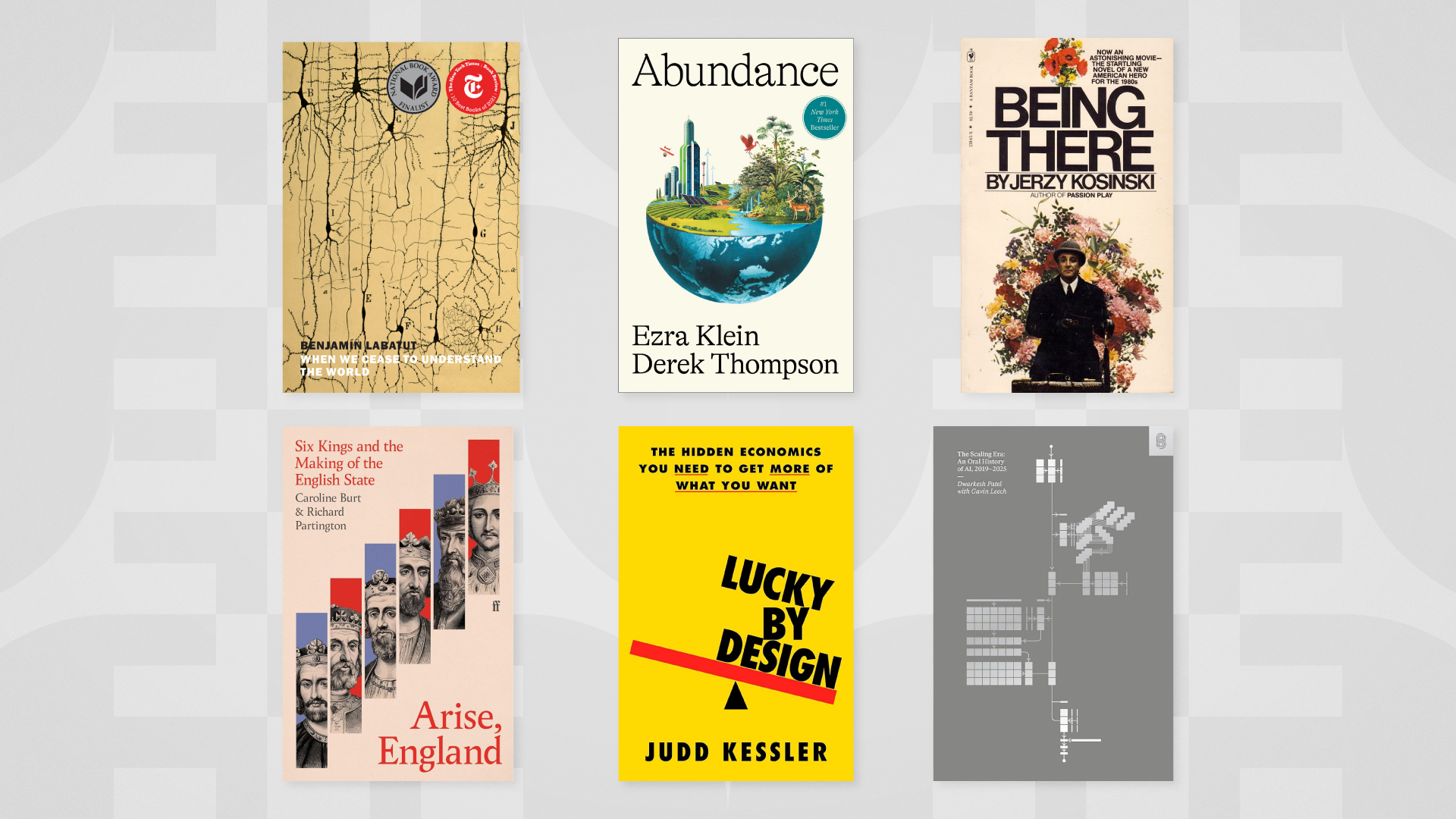
Abundance by Ezra Klein and Derek Thompson
In Abundance, Klein and Thompson argue that the U.S. has lost its capacity to build (across housing, energy, healthcare, infrastructure, etc.), and that restoring it will require a New Deal-style revival of the state. They call for approving projects at “warp speed,” fast-tracking permitting, and replacing decades of procedural drag with a bias toward action. One devastating illustration of the current dysfunction is the story of a housing complex for the homeless in San Francisco: a project funded by Charles and Helen Schwab was built quickly and affordably only because public funds were avoided. Private philanthropy achieved what government routinely struggles to deliver…and for roughly half the time and cost. What does it say about the state of our system where public process so often obstructs progress?
The Technological Republic by Alex Karp and Nicholas Zamiska
Where Abundance seeks a stronger public sector, The Technological Republic calls for the private sector to step up and serve. The authors argue that American tech companies depend on the U.S. government (for security, infrastructure, legal protections, etc.), yet they rarely offer much support in return. Karp and Zamiska blame Silicon Valley for what they describe as its fixation on chasing consumer demand. The Palantir team is talking its own book here — and while the moralizing is compelling — I believe it misses how a great deal of innovation happens in practice. GPUs were initially designed to render video-game graphics, now they’re powering today’s AI boom. The very firms that put the “silicon” in Silicon Valley, like Fairchild Semiconductor and Intel, succeeded not by pursuing fat, predictable Pentagon contracts but by building chips cheap and reliable enough for consumer electronics — components the military would, of course, come to depend on. As Chris Miller writes in his excellent book Chip War: “Only consumer markets had the volume to fund the vast R&D programs that Moore’s Law required.”
So which path is right: Abundance’s push to rebuild state capacity, or The Technological Republic’s call for a more civically minded private sector? Probably we need both: a government capable of executing big projects and companies that support the country’s long-term health. Read together, these two books highlight two sides of the same problem, and they point toward possible solutions.
Andy Hall, research
Being There by Jerzy Kosinski
The timeless story that makes you smarter and more skeptical. Read (or re-read) this classic and ask yourself, which public figures today are modern-day Chauncy Gardiners?
Not According to Plan: Filmmaking Under Stalin by Maria Belodubrovskaya
An amazing deep-dive on the folly of Stalin’s efforts to create a top-down cultural apparatus for cinema.
Arise, England by Caroline Burt and Richard Partington
A brilliant exploration of how the English state emerged, not because of a series of intentional, principled moments of design but because of a series of self-interested bargains between monarchs and their magnates. Obvious lessons for governance design everywhere, including in crypto.
Maggie Hsu, go-to-market
Humankind by Rutger Bregman
I tend to have a cynical view of human nature, and a friend gave me this book in an attempt to argue the other side. Reading it left me more hopeful about our society. It has also helped me better answer my toddler’s latest question of “how does someone become a bad guy or a good guy?”
Scott Duke Kominers, research
Lucky by Design by Judd B. Kessler
This book — by my former grad school officemate Judd Kessler — is the best out there on what market design means for our everyday lives. Kessler illustrates the mechanics of all manner of markets, and how to make them equitable, efficient, and easy to be a part of. It’s a perfect complement to several of my recommendations from prior years, such as Who Gets What — And Why and The Inner Lives of Markets.
Murder in the House of Omari by Taku Ashibe
This utterly brilliant mystery novel is a multi-act tragedy set inside a panorama of social and industrial change in early–20th-century Japan. The titular Omari family’s prewar rise and postwar decline wraps in upon itself in an ouroboros of puzzling murders, with clues that leave nothing hidden yet nevertheless somehow manage to obscure.
The Scaling Era: An Oral History of AI, 2019–2025 by Dwarkesh Patel with Gavin Leech
The Scaling Era was simultaneously the most readable and the most comprehensive book on AI I came across last year: A series of high-energy conversations on the science, purpose, and potential of AI; framed with Talmud-style footnotes, annotations, and asides that make it possible to zoom in on any idea to arbitrarily high resolution. Not just a masterpiece of nonfiction writing, but also of book conceptualization and design.
Across the Universe: The Past, Present, and Future of the Crossword Puzzle by Natan Last
Book for wordplay enthusiasts and technologists (or for traveling in a spaceship?), especially for one down to rethink the grid.
A Woven Year by Jessie Mordine Young
In 2023, Young undertook a project of daily weaving, creating 365 “tactile sketches” from handspun fibers and found objects. The whole series has been beautifully photographed and woven together into this volume, perfect for quiet contemplation or as a coffee table book.
The William Lowell Putnam Mathematical Competition 1985–2000: Problems, Solutions and Commentary by Kiran S. Kedlaya, Bjorn Poonen, and Ravi Vakil
With AI agents catching up, there’s never been a better time to immerse oneself in the joy of classic Putnam problems. The MAA/AMS Putnam compilation series does a beautiful job illustrating multiple approaches to the problems, as well as their linkages to various branches of research mathematics. All are fantastic, but I’m especially partial to the 1985–2000 volume, which features some particularly interesting years of the exam. (Check out for example problem 1998A3, and the seemingly superficially related yet massively more difficult 1999B5. Also 1998B6!)
Shuna’s Journey by Hayao Miyazaki
An illustrated mini-epic by legendary animation director Hayao Miyazaki: Shuna’s Journey has all the majesty of a Studio Ghibli film, but in the form of a book that you can hold in your hands. Written in the early ’80s, but only recently translated into English for the first time.
Fibonacci and Lucas Numbers with Applications by Thomas Koshy
If you, like me, are the type of person who enjoys leafing through the encyclopedia and also loves Fibonacci numbers, then imagine how awesome it would be to have an encyclopedia of Fibonacci numbers! QED.
Eddy Lazzarin, engineering
The Collapse of Complex Societies by Joseph Tainter
Joseph Tainter’s “The Collapse of Complex Societies” argues that civilizations are problem-solving organizations that can eventually succumb to diminishing marginal returns, and then — when there are no neighbors to absorb them — collapse. Every good layer of bureaucracy or technology creates benefits, but eventually gets squeezed to the point that it costs more than it is worth. If a society doesn’t invest wisely in productivity improvements (particularly energy production) and intentionally shed costly burdens, nature eventually liquidates (simplifies) it.
This book is a rigorous academic text — readers who want to economize can stick to chapters 2, 4, and 5.
Jason Rosenthal, operations
The Prize: The Epic Quest for Oil, Money and Power by Daniel Yergin
The Prize is the definitive history of the oil industry, tracing its roots from the 1850s through the invention of hydraulic fracking. The courage, risk-taking and invention that characterized the entrepreneurs of the early oil industry rivals anything we’ve seen in the modern Silicon Valley. By understanding oil’s impact on economic growth and geopolitics, one can get a sense of how far-reaching the implications of crypto and AI are likely to be over the course of the next century.
Arianna Simpson, investing
The MANIAC by Benjamín Labatut
A novel-like and very creative exploration of the personality and life of John von Neumann, celebrated Hungarian-American physicist and computer scientist.
Aiden Slavin, policy
Breakneck: China’s Quest to Engineer the Future by Dan Wang
Breakneck will make you rethink your basic assumptions about China (and by extension the rest of the modern world). Wang brings a savvy eye—and a tolerance for dissonance—to issues as diverse as bridge building (literally), zero-COVID, and the one-child policy. Considered, fast-paced, and uncommonly well-written, Breakneck consistently goes beyond tired political conventions by foregrounding the human implications of Chinese Communist Party rule.
Helen Stoddard, events
Simply More: A Book for Anyone Who Has Been Told They’re Too Much by Cynthia Erivo
Part biography, part behind the scenes and part life inspiration, this book is a charming and cozy read. I was inspired by both how Cynthia has overcome challenges in her life and career as well as her preparation and mindset to be able to accept and excel when opportunities presented themselves. It’s no accident that she was able to ‘defy gravity’ when the cameras rolled for her star turn in film sensation Wicked. Bonus: She reads the book herself for those who prefer audio books — and her ASMR is top notch!
All the Way to the River: Love, Loss, and Liberation by Elizabeth Gilbert
This was an intensely personal story about addiction, codependency, death. But more than that, it was an exploration by the author of how she lived her life, how she loved her people and how change was required for her own survival. Liz Gilbert has mined her own life for previous works Eat, Pray, Love, and Committed — but neither had the grit and resolution that this work did. More empowering than uplifting, and more cautionary tale than inspiration, this book was a really emotional read that really lands in your heart if you let it.
Tim Sullivan, editorial
Back from the Brink: Inside the NYPD and New York City’s Extraordinary 1990s Crime Drop by Peter Moskos
Moskos — whose earlier books include an account of his year on the front lines of the war on drugs in Baltimore’s Eastern District — tells the story of how the NYPD cleaned up the city after a disastrous era of the 1970s and 1980s. Crime was out of control, but then, between 1993 and 1996, the police were able to cut the city’s murder rate by more than half, helping to turn NYC into the safest big city in the country. This book tells how that happened. Part of what makes the book compelling is that Moskos lets the police and civic leaders speak for themselves, telling their own, sometimes raw stories of how they accomplished their task.
Index, A History of the: A Bookish Adventure from Medieval Manuscripts to the Digital Age by Dennis Duncan
Duncan, a professor of English at University College London, traces the path of the index — the always-useful compendium of words and ideas buried at the back of a book — from its proto-origins at the Library of Alexandria through modern search engines. Along the way, you’ll learn the history of alphabetization, how accused heretics used the index to defend themselves, how political opponents used the index to take pot shots at one another, and more. It’s delightful, even if you’re not a word nerd.
The Chronicles of Prydain
If you like fantasy series aimed at younger readers (or if you have younger readers in your life), I highly recommend the Chronicles of Prydain. Loosely based on Welsh mythology, the series follows Taran, an assistant pig keeper, on his hero’s journey with his friends. It’s funny, fun, and alternately lighthearted and searching. The series was published in the ’60s and seems to have fallen off the radar. Start with The Book of Three.
Em Westerhold, finance & ops
What Kind of Paradise by Janelle Brown
What Kind of Paradise is a compelling blend of coming-of-age novel and page-turning thriller. For anyone familiar with the Silicon Valley ecosystem, it feels especially emotionally resonant, exploring the pull of techno-optimism alongside the more complicated human consequences of rapid progress. It’s relatable and suspenseful, making it a great choice for a fun, immersive winter break read.
Guy Wuollet, investing
When We Cease to Understand the World by Benjamín Labatut
Labatut combines a wonderful love of actual physicists and scientific discoveries with a taste for embellishment and the melodramatic to make one of the most fun books I’ve read this year.
Hagakure by Yamamoto Tsunetomo
“The Way of the Samurai is in desperateness. Ten men or more cannot kill such a man. Common sense will not accomplish great things. Simply become insane and desperate.”
Need I say more?
Ametora: How Japan Saved American Style by W. David Marx
I’ve come to really enjoy menswear, most of which happens to be made in Japan. I was fascinated to understand why the highest quality American style clothing all happened to be made in Japan, and this book opened a whole new world I never knew about.
Sun and Steel by Yukio Mishima
This essay/book is impossible to describe, but I’ll try. Sun and Steel is a meditation on beauty, the physical form, death, and on just doing things.
Stephanie Zinn, editorial
Michelangelo: the Artist, the Man and His Times by William E. Wallace
I will occasionally trot out anecdotes from this biography at a party or an otherwise fun gathering of friends. While I’ve seen a lot of eyes glaze over, I’m convinced there is an audience somewhere out there for my niche preoccupations, so here we go:
Around 1506 — a few years before he began work on the ceiling of the Sistine Chapel — Michelangelo Buonarroti traveled to Bologna. When he got there, he was recognized by attendants of Pope Julius II and promptly brought before his Holiness, whom Michelangelo had essentially left on read. Bold! Pope Julius then commissioned a bronze sculpture of himself with a giant sword to show everyone who was boss. Michelangelo — who wasn’t used to working in bronze, or in Bologna — complained prolifically in letters to his family. He bemoaned his “terrible room” and the heat “such that one cannot believe it is worse anywhere in the world,” but he did not write much about the plague raging in the city at the time, or about the unruly mob that sacked and burned an entire palace to the ground. He was simply that locked in.
If you find this delightful, read the whole biography. Michelangelo was, in fact, not a party dude. He was a charming (in my opinion) curmudgeon with near-delusional ambition.
Plus more recommendations from our founders…
This year, we asked founders attending our crypto Founders Summit what they’d been reading. Here are a few of their favorites:
- Cable Cowboy: John Malone and the Rise of the Modern Cable Business by Mark Robichaux – Zach Abrams, cofounder, Bridge
- The Courage to Be Disliked: The Japanese Phenomenon That Shows You How to Change Your Life and Achieve Real Happiness – Justin Blau, CEO, Royal
- The Machiavellians: Defenders of Freedom by James Burnham – Michael Blau, Crypto Product and Protocol Design, Royal
- Sapiens: A Brief History of Humankind by Yuval Noah Harari – Sreeram Kannan, founder and CEO, Eigenlayer
- Originals: How Non-Conformists Move the World by Adam Grant – Ben Leventhal, founder and CEO, Blackbird
- Void Star: A Novel by Zachary Mason – Ryan Ouyang, founder, IYK
- Lonesome Dove by Larry McMurtry – Bryan Pellegrino, cofounder and CEO LayerZero Labs
- Hyperion Cantos by Dan Simmons – Hilmar Pétursson, CEO CCP Games
- Reality Transurfing, a series by Vadim Zeland – Emily Yang, cofounder, Shibuya
***
The views expressed here are those of the individual AH Capital Management, L.L.C. (“a16z”) personnel quoted and are not the views of a16z or its affiliates. Certain information contained in here has been obtained from third-party sources, including from portfolio companies of funds managed by a16z. While taken from sources believed to be reliable, a16z has not independently verified such information and makes no representations about the current or enduring accuracy of the information or its appropriateness for a given situation. In addition, this content may include third-party advertisements; a16z has not reviewed such advertisements and does not endorse any advertising content contained therein.
You should consult your own advisers as to those matters. References to any securities or digital assets are for illustrative purposes only, and do not constitute an investment recommendation or offer to provide investment advisory services. Furthermore, this content is not directed at nor intended for use by any investors or prospective investors, and may not under any circumstances be relied upon when making a decision to invest in any fund managed by a16z. (An offering to invest in an a16z fund will be made only by the private placement memorandum, subscription agreement, and other relevant documentation of any such fund and should be read in their entirety.) Any investments or portfolio companies mentioned, referred to, or described are not representative of all investments in vehicles managed by a16z, and there can be no assurance that the investments will be profitable or that other investments made in the future will have similar characteristics or results. A list of investments made by funds managed by Andreessen Horowitz (excluding investments for which the issuer has not provided permission for a16z to disclose publicly as well as unannounced investments in publicly traded digital assets) is available at https://a16z.com/investment-list/.
The content speaks only as of the date indicated. Any projections, estimates, forecasts, targets, prospects, and/or opinions expressed in these materials are subject to change without notice and may differ or be contrary to opinions expressed by others. Please see https://a16z.com/disclosures/ for additional important information.