
South Korea has long played a very specific role in the global crypto ecosystem.
In the 2017 and 2021 cycles, the country became one of crypto’s most important retail markets. Korean exchanges could move meaningful volume; local investors had an appetite for new tokens; and listings on its largest exchanges, Upbit and Bithumb, became major milestones for projects seeking liquidity, holders, and market awareness.
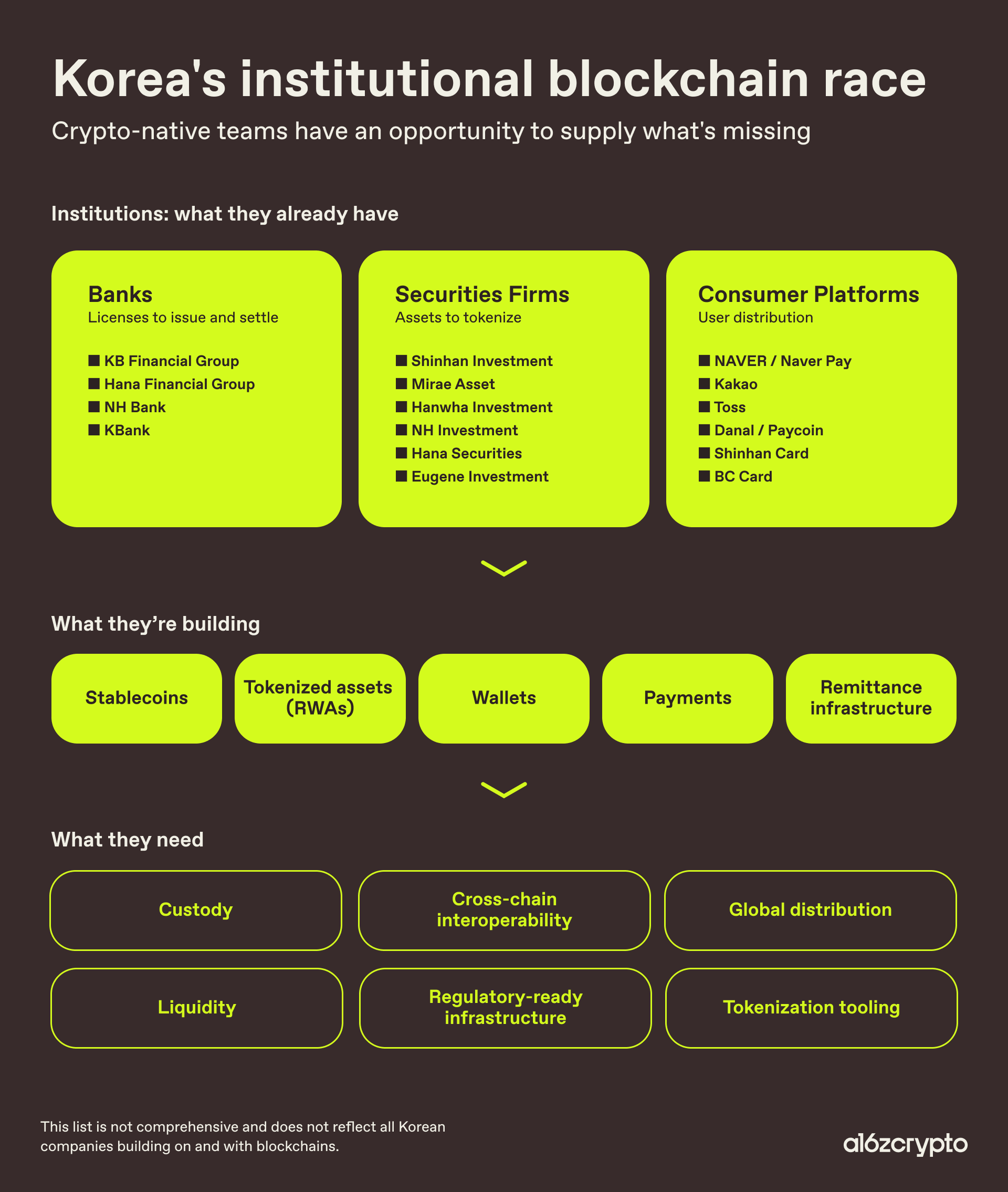
That retail market is quieter now, but a more structural shift is underway. Some of Korea’s largest financial institutions and internet platforms are using this window to build on the country’s retail foundation — a push for institutional infrastructure driven by two trends, in particular: stablecoins and real-world asset (RWA) tokenization.
This guide is written for companies outside Korea who want a high-level map of that landscape, for partnerships or other collaborations. Many of these pilots and partnerships are already known locally, and many are still developing in real time. My goal is to highlight a few emerging patterns as a starting point for teams not based in Korea: which institutions are moving, what they are building, and where crypto-native projects may be able to help them.
Stablecoins are moving into the mainstream
Stablecoins are now a mainstream policy and business priority in Korea. The question currently being hashed out among policymakers, banks, and other industry players is whether Korea will create a regulated market for won-backed stablecoins.
At the center of the debate is who will be allowed to issue them: Banks want a bank-led model. Fintech and internet platforms want room to compete. And regulators are weighing the benefits of innovation against the tradeoffs of monetary control.
The urgency here comes from dollar-based stablecoin adoption. South Korea is watching an estimated $115 billion flow in capital move offshore to overseas exchanges, much of it into dollar-denominated stablecoins like USDC — meaning more payment, trading, and remittance activity happens outside domestic financial rails.
So a regulated KRW stablecoin is more than a product opportunity. For Korean banks and policymakers, it’s seen as a defensive move: a way to keep future digital money activity tied to the won, local institutions, and Korean regulation.
For now, much of the activity is still in pilot stages. Institutions aren’t sitting still, but they are working under real constraints. They can test, partner, and prepare — but they cannot fully commit until the legal framework is clearer. So what are they doing now?
Banking
KB Financial Group
As one of Korea’s most established institutions, KB Financial Group has delivered a credible proof point that gives other banks the confidence and blueprint to move forward. When an industry leader successfully demonstrates a case study like this, it removes much of the uncertainty that typically makes large enterprises hesitate, and that changes the calculus for the entire industry.
Earlier this year, the group’s banking arm tested real payments and remittance flows, including QR-code payments at major Korean coffee chain Hollys Coffee and cross-border remittances to Vietnam completed in under three minutes, reportedly at 87% lower cost than SWIFT. The significance isn’t the scale of this pilot itself; it’s that one of the country’s largest banks has actively completed end-to-end blockchain-based financial services.
Hana Financial Group
Among major financial groups, Hana Financial Group has moved quickly — and its recent investment in Dunamu, which operates Korea’s largest crypto exchange, helps explain why. Hana is now Dunamu’s fourth-largest shareholder, giving the financial group a more material strategic link to Korea’s crypto ecosystem than other traditional institutions.
This connection is showing up in the work. Hana is part of a multi-institution stablecoin consortium running remittance tests on GIWA, Dunamu’s own blockchain network, while Hana Card is already piloting live USDC payments for foreign visitors.
NH Bank
Other banks are moving more selectively, often based on their existing advantages. For instance, NH Bank, one of Korea’s major commercial banks, is working with NHN KCP, a large payment gateway, on stablecoin-based merchant settlement — a practical use case for retailers and payment processors.
KBank
KBank, Korea’s first internet-only bank, has a different edge as Upbit’s exclusive banking partner, which gives it direct exposure to crypto users and exchange-linked payment flows. It’s now exploring a stablecoin wallet and remittance services, including work with Ripple.
Payments and Card Networks
Shinhan Card
On the card side, one of the country’s largest payment companies Shinhan Card partnered with the Solana Foundation to build real-world stablecoin payment infrastructure.
With 28 million cardholders and 200 trillion won (approximately $145 billion) in annual transaction volume, Shinhan Card brings the kind of distribution that makes this partnership genuinely meaningful, not just symbolic.
BC Card
BC Card, one of Korea’s largest payment networks, is less visible to consumers than individual card brands like Hyundai Card or Samsung Card, because it operates underlying processing and settlement infrastructure that banks and other issuers rely on. In late 2025, BC Card completed a two-month pilot that let foreign visitors spend stablecoins with Korean merchants. By routing stablecoins through the established card authorization-and-settlement layer, the pilot addressed the volatility and real-time reconciliation problems that had previously kept stablecoins out of domestic card payments.
Danal
Outside traditional finance, Danal is one of the more interesting companies to watch, because they’re starting from a very different position than many crypto-native payment projects.
The company has spent decades building payment infrastructure in Korea and operates Paycoin, a digital payments network that reaches 3.2 million users and 150,000 merchants. It launched its won-pegged Korean Stable Coin (KSC) at Korea Blockchain Week 2025 and became the first Korean company to join Circle’s Alliance Program. The significance of this move is less about the stablecoin itself, and more about distribution. Through Paycoin, Danal already has consumer and merchant relationships that many stablecoin projects are still trying to build.
Consumer platforms
KakaoPay and NAVER Pay
In Korea, internet platforms often have financial distribution advantages, as consumer hubs with enormous reach. These platforms sit within daily consumer behavior through a variety of services, from search and messaging to banking and shopping.
This position gives internet platforms something banks usually have to work harder for: high-frequency user relationships, and wallet-like interfaces already embedded in everyday life.
A quick lay of the land for those outside Korea:
- KakaoPay sits inside the Kakao ecosystem, which includes Korea’s dominant messaging app, KakaoTalk.
- NAVER is the country’s dominant internet platform, occupying the role that Google holds elsewhere, running Korea’s largest search engine, news aggregator, and digital payment service through Naver Financial.
- Naver Financial has also agreed to acquire Dunamu, the company behind Upbit, Korea’s largest crypto exchange, further underscoring the expansion of Korea’s internet platforms across payments, financial services, and digital assets.
Both Kakao and NAVER are embedded in services where hundreds of millions of transactions flow through every year. Both have signaled interest in stablecoins as part of their long-term payments strategy. KakaoPay, for its part, has declared the won stablecoin its second growth axis for international expansion.
Implications for crypto companies
The bottom line for crypto-native projects is that the market is early, but relationships are already being built. By the time regulation in Korea clears, many of the important choices may already have been made: which chains institutions trust, which wallets they integrate, which custody providers they use, and which teams they already know.
That means the window for relationship building is open now. Korean institutions are still learning what blockchain infrastructure can do in practice. The projects that show up, make themselves useful, and work with institutions at their own pace will have a much better chance of becoming part of Korea’s stablecoin infrastructure when the market opens more fully.
Some good examples of this are Solana’s partnership with Shinhan Card; Avalanche hosting KRW1; LayerZero partnering with Korea Gold Exchange and Nexpace, which is Nexon’s blockchain subsidiary; and Kaia powering KB’s end-to-end stablecoin pilot. None of these happened because those networks waited to be invited — these relationships were built proactively by crypto-native companies.
The same dynamic plays out at the infrastructure layer. Fireblocks is embedded inside NH Bank’s tokenization stack. BitGo established a dedicated Korean entity with Hana Financial (25% stake) and SK Telecom (10%) as co-investors. These are structural integrations that were built before the regulatory framework was clear.
Traditional financial institutions move deliberately, build consensus carefully, and take time to trust. The crypto-native projects that will win in Korea are the ones willing to match that rhythm without losing their edge: the very thing that makes them compelling to these companies.
RWAs: From pilot to pipeline
Korea’s tokenized asset market tells a very similar story to stablecoins. Regulation is still catching up, but institutional commitment has translated into real infrastructure faster than most outside observers have noticed.
Most global discussion around RWAs focused on U.S. Treasuries or private credit. Korea’s approach casts a much wider net, while being more locally specific. Securities firms are already running sandbox-stage issuances across real estate, bonds, gold, carbon credits, and short-term debt.
But the more interesting activity is actually happening around assets tied to Korea’s industrial and cultural strengths: Mirae Asset Securities (one of Korea’s largest securities firms) working with Korea Land Trust and HJ Heavy Industries (a major shipbuilder) to explore tokenized ship financing. Hanwha Investment & Securities (part of the Hanwha conglomerate) announced plans to tokenize assets from Hanwha Group’s defense supply chain. Story Protocol is partnering with Seoul Exchange, a fractional investment platform, to bring K-pop royalties and creative IP onchain.
Both Mirae and Hanwha are owner-driven organizations, which matters in a market where long-term conviction and speed of decision-making can be an advantage. Mirae Asset has been aggressive across blockchain generally, building its own products instead of waiting for the ecosystem to mature around it. Hanwha has staked out one of the more specific roadmaps in the market, including a retail-facing tokenized security platform planned for mid-2026 and tokenization work tied to Hanwha Group’s defense supply chain.
Taken together, these partnerships suggest that Korea’s RWA market is developing around sectors where Korea already has global strengths, like shipping, industrial supply chains, and entertainment — instead of coalescing around some global playbook.
The legal foundation is also coming into place. In early 2026, the National Assembly passed amendments to the Capital Markets Act and Electronic Securities Act, creating a clearer path for security token offerings. The law does not take effect until early 2027, so meaningful volume is still limited, but the framework is already forming.
Two competing platforms have received preliminary approval to operate the trading systems that would let tokenized securities be issued, bought, sold, and settled under Korea’s new framework: NXT, backed by Shinhan Investment Securities, Hana Securities, and Eugene Investment; and KDX. The Korea Exchange is also building a complementary secondary market — addressing liquidity after issuance — which is one of the biggest gaps in tokenized assets globally.
Shinhan Investment Securities is the early frontrunner. It completed 10 investment contract issuances in 2025 and has built a 50-plus-firm alliance around the NXT platform. NH Investment Securities and Mirae Asset Securities are close behind, with pipelines extending into maritime assets and IP. None of these partnerships are large-scale yet, but the positions being staked now will be hard to dislodge once the market opens to them.
Implications for crypto-native projects
Korea’s securities firms have strong fundamentals. They also have the regulatory licenses, institutional relationships, and asset pipelines. What they don’t have is the infrastructure layer around them, and that’s where crypto-native projects can find the biggest opportunities.
Three gaps matter most:
- Global distribution. Korean institutions are tokenizing assets that global investors might want, but they still need ways to reach those investors. Crypto-native projects that can help bridge that gap that most domestic institutions can’t fill on their own, connecting Korean issuers to liquidity pools and buyers outside Korea.
- Liquidity and cross-chain interoperability. A tokenized asset trapped on one chain is only marginally better than a traditional security. LayerZero’s work with Korea Gold Exchange Digital Asset shows the role interoperability providers can play. Its partnerships around tokenized gold are broadly intended to let the asset move across multiple chains without fragmenting liquidity across separate wrapped tokens. The bigger opportunity here is helping tokenized assets reach more markets without becoming trapped inside a single venue or chain.
- Infrastructure that supports rather than competes. These institutions know their business and have their own core assets. They’re not looking to be disrupted. The projects that win here are the ones that make Korean institutions better at what they already do, which is structuring, distributing, and managing tokenized assets at scale. The picks-and-shovels opportunity in Korean RWA is still largely unclaimed.
So where are the users?
The most consequential crypto move in Korea right now may actually be happening at the consumer platform layer.
In late 2025, NAVER confirmed its acquisition of Dunamu, the operator of Upbit. The deal still requires regulatory approval, but the outlook is optimistic. If it closes, NAVER Financial would combine Korea’s largest crypto exchange with Naver Pay’s 34 million users.
This combination matters because it brings retail crypto trading infrastructure and everyday consumer payments, which usually sit apart. NAVER has also been developing its own wallet infrastructure, while Dunamu built Giwa, an OP Stack-based L2, signaling that Upbit’s ambitions extend well beyond exchange operations and into onchain business.
Kakao is taking a different route, with work happening at the subsidiary level. KakaoBank has been exploring stablecoin development, hiring blockchain engineers and building toward a KRW-pegged coin.
Coming off its first annual profit and positioning blockchain as its next growth axis, the company is building toward a super wallet. This could be a unified interface spanning KakaoPay, KakaoBank, and KakaoTalk that can hold fiat currency and stablecoins.
Together, NAVER and the Kakao ecosystem represent two of the most powerful consumer distribution channels in the country, both moving toward blockchain-as-infrastructure rather than feature.
Finally, there’s Toss, which holds banking, securities, and insurance licenses — and its app already behaves like a financial wallet. In mid-2025, Toss filed trademarks for 24 won stablecoin names and stood up a dedicated blockchain unit. It has also indicated that a proprietary L1 mainnet with an integrated wallet is something it may explore down the road.
Toss’s payments infrastructure already runs deep. Beyond digital transfers, Toss has deployed physical point-of-sale terminals in offline merchants across the country, giving it a footprint that extends from app to physical retail. Payments and remittance are two of the clearest near-term use cases for stablecoins, and Toss is already embedded in both.
For crypto native projects, this is the distribution layer to watch. Banks may shape issuance and compliance, and securities firms may shape tokenized assets. Consumer platforms, however, can decide how blockchain products actually reach users.
Korea is at an inflection point. The regulatory framework is coming together, institutional infrastructure is being built, and the question is no longer whether Korea’s establishment will engage with blockchains — they already are — it’s which projects and protocols will become part of that infrastructure?
One external factor worth watching is the U.S. CLARITY Act. Korean institutions don’t move in a vacuum. As the U.S. works toward clearer crypto market structure domestically, it also gives international regulators including Korean agencies and institutions a very helpful reference point. Clearer U.S. rules would make it easier for Korean institutions to make the case for deeper blockchain integration internally.
Korea already has what it needs when a regulatory framework arrives — including deep retail engagement, sophisticated financial institutions that have already done the groundwork, and a tech-native population that understands and uses digital assets at scale. The crypto companies that have spent this period building genuine relationships and real use cases alongside Korean institutions will help define what’s next.
I’ll share more on other markets across Asia next.
***
The views expressed here are those of the individual AH Capital Management, L.L.C. (“a16z”) personnel quoted and are not the views of a16z or its affiliates. Certain information contained in here has been obtained from third-party sources, including from portfolio companies of funds managed by a16z. While taken from sources believed to be reliable, a16z has not independently verified such information and makes no representations about the current or enduring accuracy of the information or its appropriateness for a given situation. In addition, this content may include third-party advertisements; a16z has not reviewed such advertisements and does not endorse any advertising content contained therein.
This content is provided for informational purposes only, and should not be relied upon as legal, business, investment, or tax advice. You should consult your own advisers as to those matters. References to any securities or digital assets are for illustrative purposes only, and do not constitute an investment recommendation or offer to provide investment advisory services. Furthermore, this content is not directed at nor intended for use by any investors or prospective investors, and may not under any circumstances be relied upon when making a decision to invest in any fund managed by a16z. (An offering to invest in an a16z fund will be made only by the private placement memorandum, subscription agreement, and other relevant documentation of any such fund and should be read in their entirety.) Any investments or portfolio companies mentioned, referred to, or described are not representative of all investments in vehicles managed by a16z, and there can be no assurance that the investments will be profitable or that other investments made in the future will have similar characteristics or results. A list of investments made by funds managed by Andreessen Horowitz (excluding investments for which the issuer has not provided permission for a16z to disclose publicly as well as unannounced investments in publicly traded digital assets) is available at https://a16z.com/investments/.
Charts and graphs provided within are for informational purposes solely and should not be relied upon when making any investment decision. Past performance is not indicative of future results. The content speaks only as of the date indicated. Any projections, estimates, forecasts, targets, prospects, and/or opinions expressed in these materials are subject to change without notice and may differ or be contrary to opinions expressed by others. Please see https://a16z.com/disclosures for additional important information.