
Every generation gets a chance to upgrade its infrastructure.
In the 1990s, it was the internet. Policymakers worried that it would disrupt existing industries and create new risks. But instead of cramming the technology into outdated regulatory boxes, lawmakers established rules that let innovation flourish while protecting consumers. The result was one of the greatest periods of economic growth in American history.
Today, we face a similar opportunity with blockchain networks. Stablecoins are making payments faster and cheaper. Tokenization is modernizing capital markets. Both depend on blockchain infrastructure.
These technologies will advance with or without Congress. It’s up to the United States whether it will set the standards, or cede that ground to others.
The GENIUS Act proved that clarity works
The GENIUS Act showed what well-considered policymaking can achieve. Stablecoins are digital dollars that move across the internet as easily as bits. Sending $200 from the U.S. to Colombia via traditional rails can cost more than $12 and take days. With stablecoins, the same transfer costs pennies and settles in seconds.
Regulatory uncertainty had for years held back stablecoin adoption. The GENIUS Act changed this. By establishing reserve requirements and a framework for issuers, it got rid of any confusion and unlocked growth.
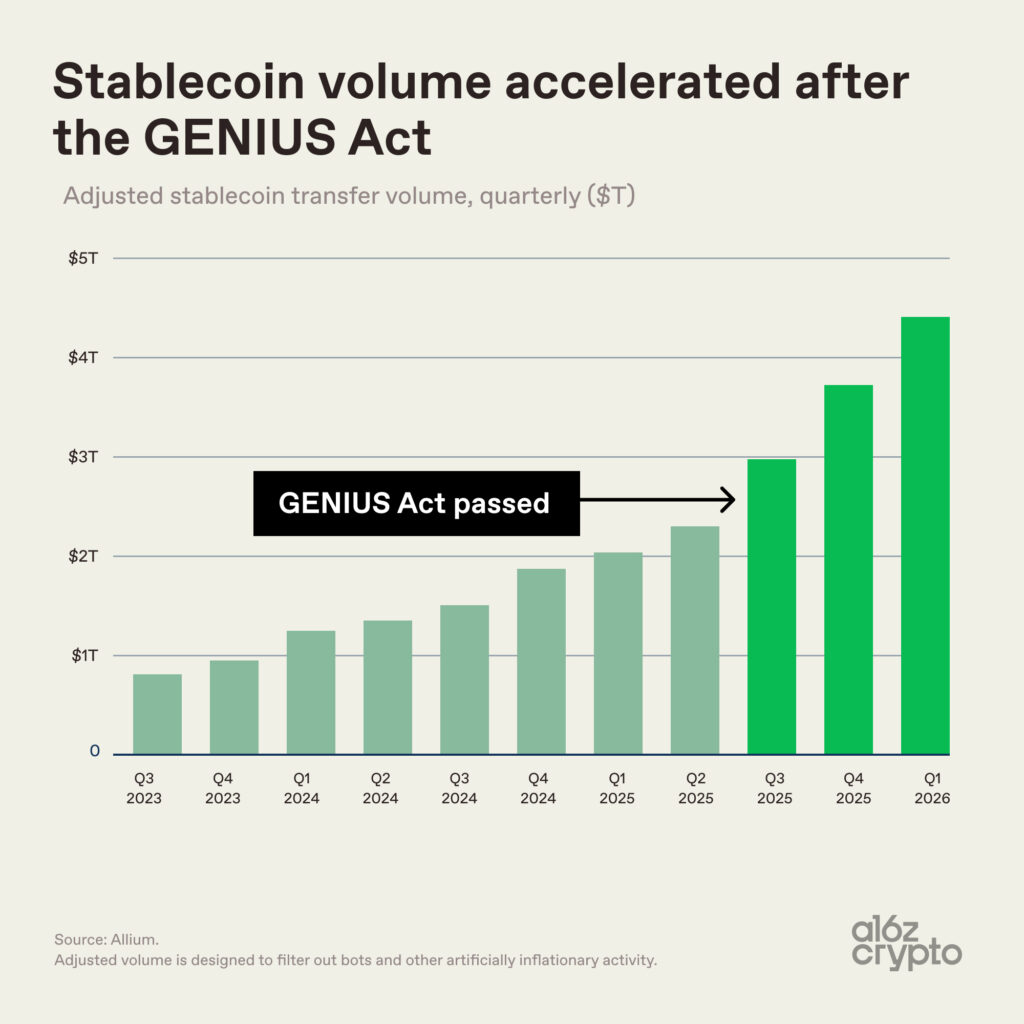
The results speak for themselves. The stablecoin market amounts to roughly $315 billion, up more than 50% from a year ago, with dollar-backed tokens becoming one of the fastest-growing channels for U.S. currency abroad. By Visa’s count, stablecoins processed $100 trillion in transaction volume over the last twelve months. Major institutions — including JPMorgan, Citi, Visa, Mastercard, and BlackRock — are drawing deeper into blockchain infrastructure.
Crucially also, the dollar is winning. Millions of people worldwide who lack easy access to traditional dollar accounts can now hold and transact in digital dollars through software wallets. Clear rules have helped anchor this new system in U.S. standards and institutions rather than in competing alternatives.
GENIUS demonstrated that smart regulation expands markets rather than constricting them. But it addressed only part of the picture.
Blockchain networks still lack rules
Stablecoins account for less than 15% of the crypto market by market cap, yet they depend on the remaining 85% of foundational blockchain networks that still operate without a coherent federal framework. This is equivalent to regulating smartphones while ignoring cellular networks.
The CLARITY Act rectifies this.
At its core, CLARITY provides clear rules for blockchain networks and defines regulatory responsibilities across digital asset markets. It creates incentives for transparency, risk reduction, and competition under a common set of standards. It helps prevent the next FTX disaster by empowering regulators to supervise intermediaries with proven principles from traditional finance: proper custody, segregation of customer assets, and full disclosure. And it opens the next wave of institutional adoption.
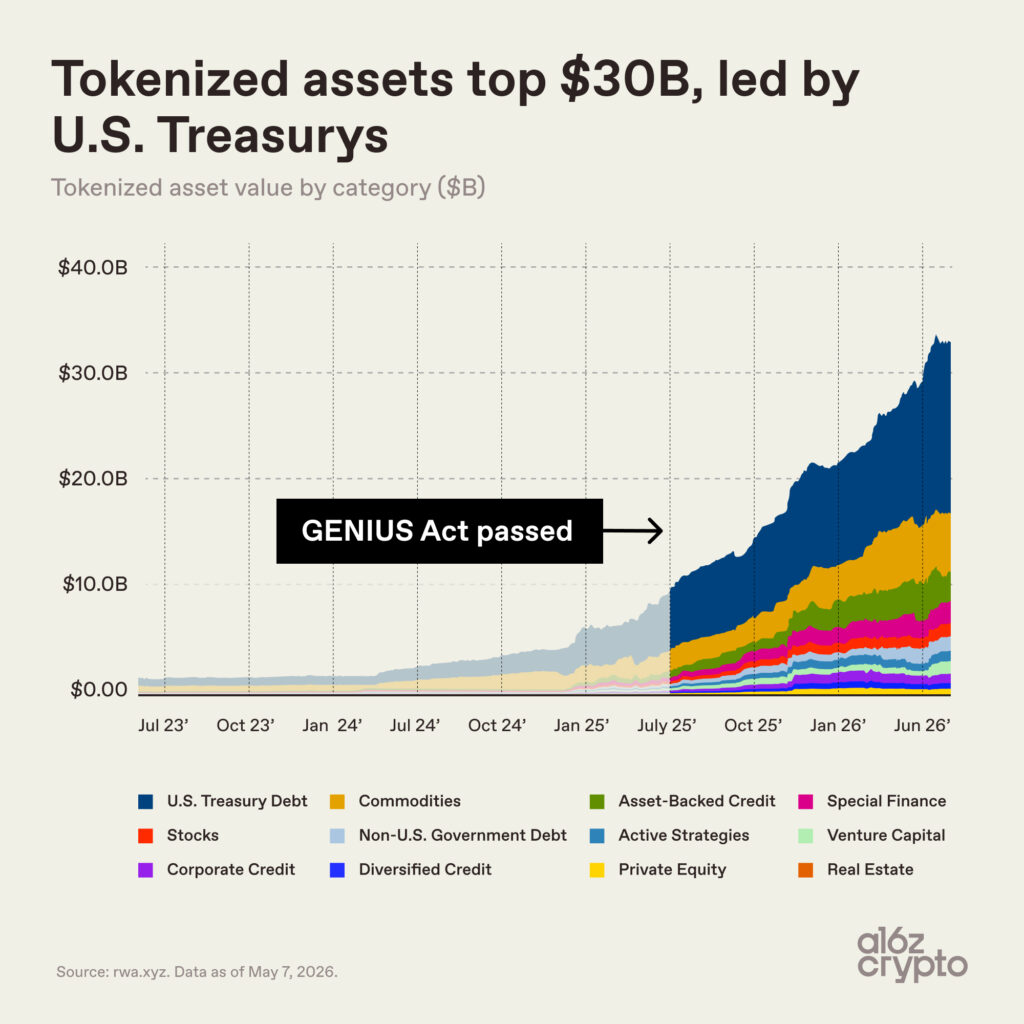
Major firms are already moving. BlackRock has launched tokenized funds. JPMorgan is building blockchain-based payment systems. And DTCC, which holds $114 trillion in assets under custody, is preparing to scale tokenized securities with the Canton Network. CLARITY removes the barriers to entry, giving traditional finance a clear pathway to participate compliantly. This benefits not just the crypto industry, but consumers, investors, and the long-term competitiveness of U.S. capital markets.
The choice before us
History shows that open, neutral platforms governed by clear rules create the greatest value. The internet succeeded because entrepreneurs knew the rules of the road. They could build, attract capital, and compete on merit rather than on regulatory guesswork. Blockchain networks deserve the same chance.
Regulation versus innovation is a false choice. GENIUS already disproved that: During the second half of 2025 — after GENIUS was signed into law — more than $13 billion flowed into crypto startup investment, nearly double the $6.9B invested pre-GENIUS in the first half of that year. Meanwhile, forecasts project the market for tokenized assets to grow 100x growth over the next few years. The choice is between certainty and uncertainty, America can assert its leadership and build the future here at home or watch it be built elsewhere.

No law is perfect, and the CLARITY Act is no different. The reality is that there are no consumer protections on crypto currently. CLARITY puts those in place. As with any bill, no one will get everything they want, but the version released today will move the industry forward. It reflects months of bipartisan negotiations and significant compromises from industry. Whatever its imperfections, the CLARITY Act is significantly better than continuing with no safeguards at all.
The decisions Congress makes this year will determine where the next era of financial infrastructure will flourish and who writes its rules. If the CLARITY Act passes, it will let the U.S. lead once again, just as it did with the commercial internet. Failing to act means innovation will migrate elsewhere, under frameworks devised by others.
***
The views expressed here are those of the individual AH Capital Management, L.L.C. (“a16z”) personnel quoted and are not the views of a16z or its affiliates. Certain information contained in here has been obtained from third-party sources, including from portfolio companies of funds managed by a16z. While taken from sources believed to be reliable, a16z has not independently verified such information and makes no representations about the current or enduring accuracy of the information or its appropriateness for a given situation. In addition, this content may include third-party advertisements; a16z has not reviewed such advertisements and does not endorse any advertising content contained therein.
This content is provided for informational purposes only, and should not be relied upon as legal, business, investment, or tax advice. You should consult your own advisers as to those matters. References to any securities or digital assets are for illustrative purposes only, and do not constitute an investment recommendation or offer to provide investment advisory services. Furthermore, this content is not directed at nor intended for use by any investors or prospective investors, and may not under any circumstances be relied upon when making a decision to invest in any fund managed by a16z. (An offering to invest in an a16z fund will be made only by the private placement memorandum, subscription agreement, and other relevant documentation of any such fund and should be read in their entirety.) Any investments or portfolio companies mentioned, referred to, or described are not representative of all investments in vehicles managed by a16z, and there can be no assurance that the investments will be profitable or that other investments made in the future will have similar characteristics or results. A list of investments made by funds managed by Andreessen Horowitz (excluding investments for which the issuer has not provided permission for a16z to disclose publicly as well as unannounced investments in publicly traded digital assets) is available at https://a16z.com/investments/.
Charts and graphs provided within are for informational purposes solely and should not be relied upon when making any investment decision. Past performance is not indicative of future results. The content speaks only as of the date indicated. Any projections, estimates, forecasts, targets, prospects, and/or opinions expressed in these materials are subject to change without notice and may differ or be contrary to opinions expressed by others. Please see https://a16z.com/disclosures for additional important information.