
Trading in perpetual futures tied to stocks, gold, and other traditional assets is growing fast. And most of that activity is happening on centralized exchanges.
These contracts, often referred to as real-world asset (or RWA) perps, give traders exposure to the prices of traditional assets without actually buying the asset itself. Unlike conventional futures, they don’t have a scheduled expiration, and some venues also offer 24-hour trading, seven days a week. This includes weekends, when major commodity futures markets and stock exchanges are closed.
Demand is rising quickly: Across tracked venues, monthly RWA perp trading volume reached $701 billion in August, up 1,148x in a year. Open interest, a measure of traders’ market exposure, reached $9.3 billion. And most of that activity is happening on centralized exchanges, which now account for 85% of RWA perp volume.
Note: While a small number of U.S.-regulated centralized platforms offer products similar to perpetual futures contracts to U.S. persons, only one venue has been approved to trade one perp at this time. All other centralized and decentralized exchanges restrict U.S. persons’ access to true perpetual futures contracts.
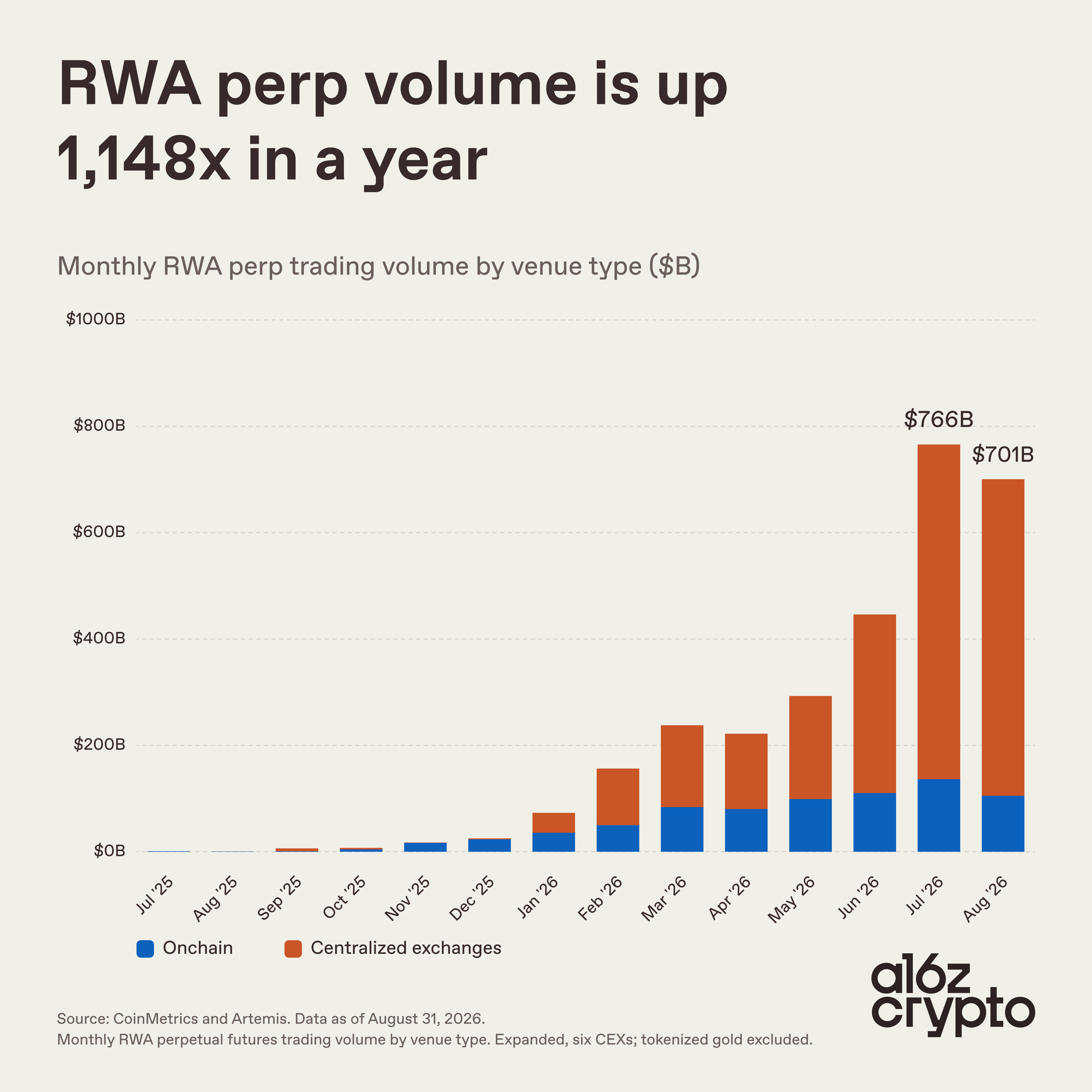
After a down month in April, volume recovered to a new high in May. It continued climbing to $766 billion in July before pulling back to $701 billion in August. Even then, monthly volume was 1,148× higher than the year before.
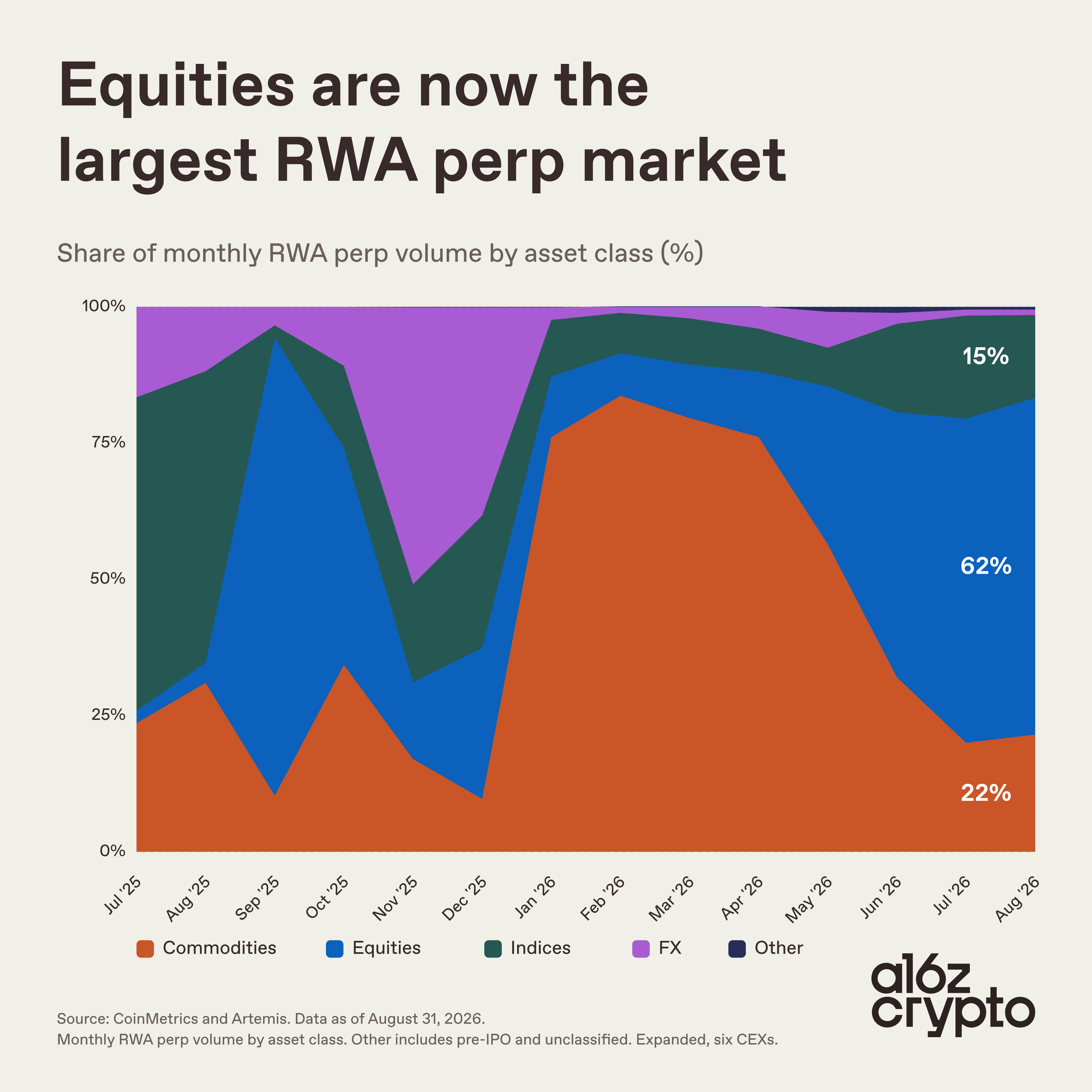
What people are trading has also changed. At the start of 2026, commodities made up roughly three-quarters of RWA perp volume and remained the largest asset class through May. Since then, the mix has shifted toward equities. As of August this year, equities make up 62% of volume, compared with 22% for commodities and 15% for indices.
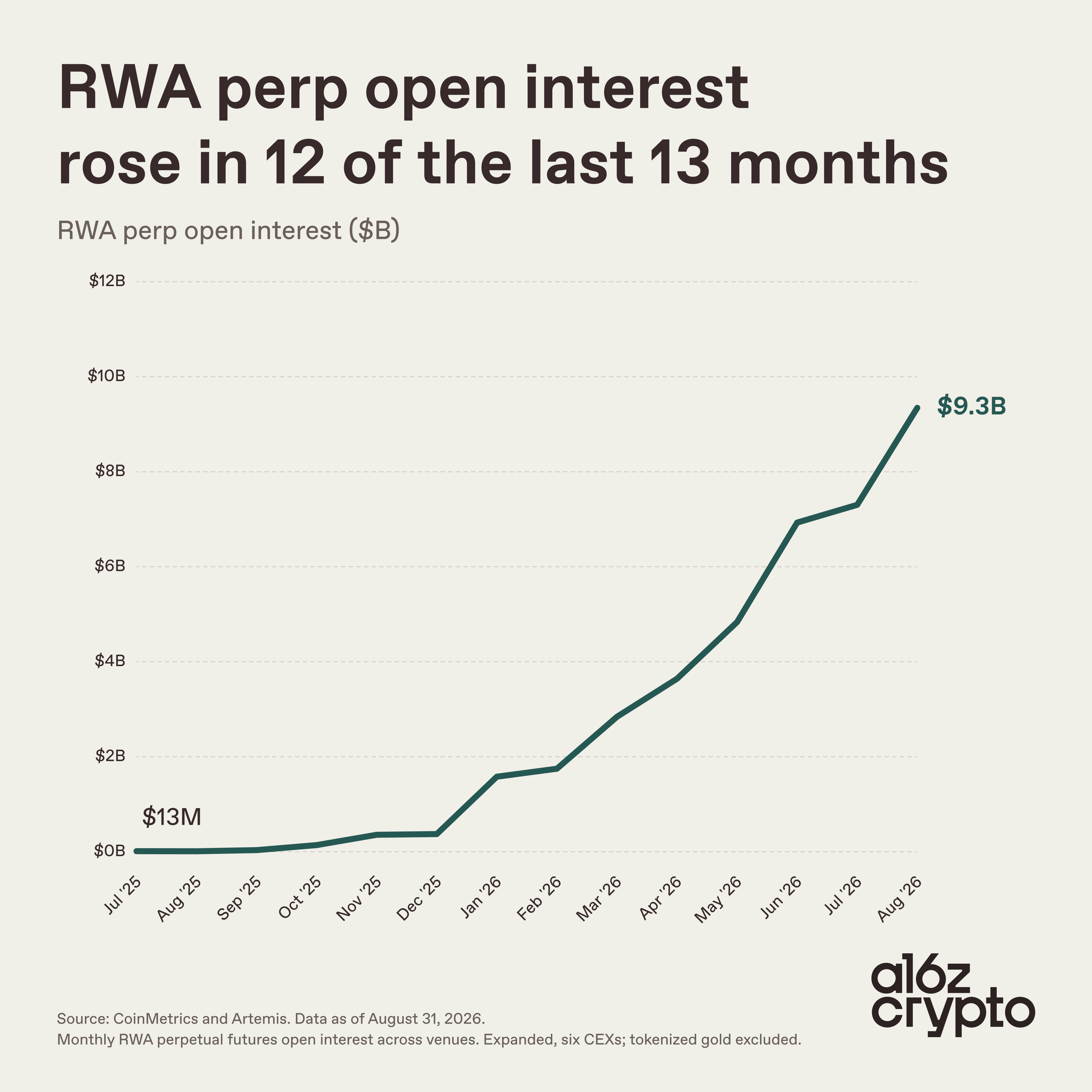
RWA perp “open interest” — which measures the notional value of outstanding contracts — climbed from $13 million in July 2025 to $9.3 billion in August 2026, increasing more than 700×. It continued to grow in April and reached a new high in August, even as trading volume fell.
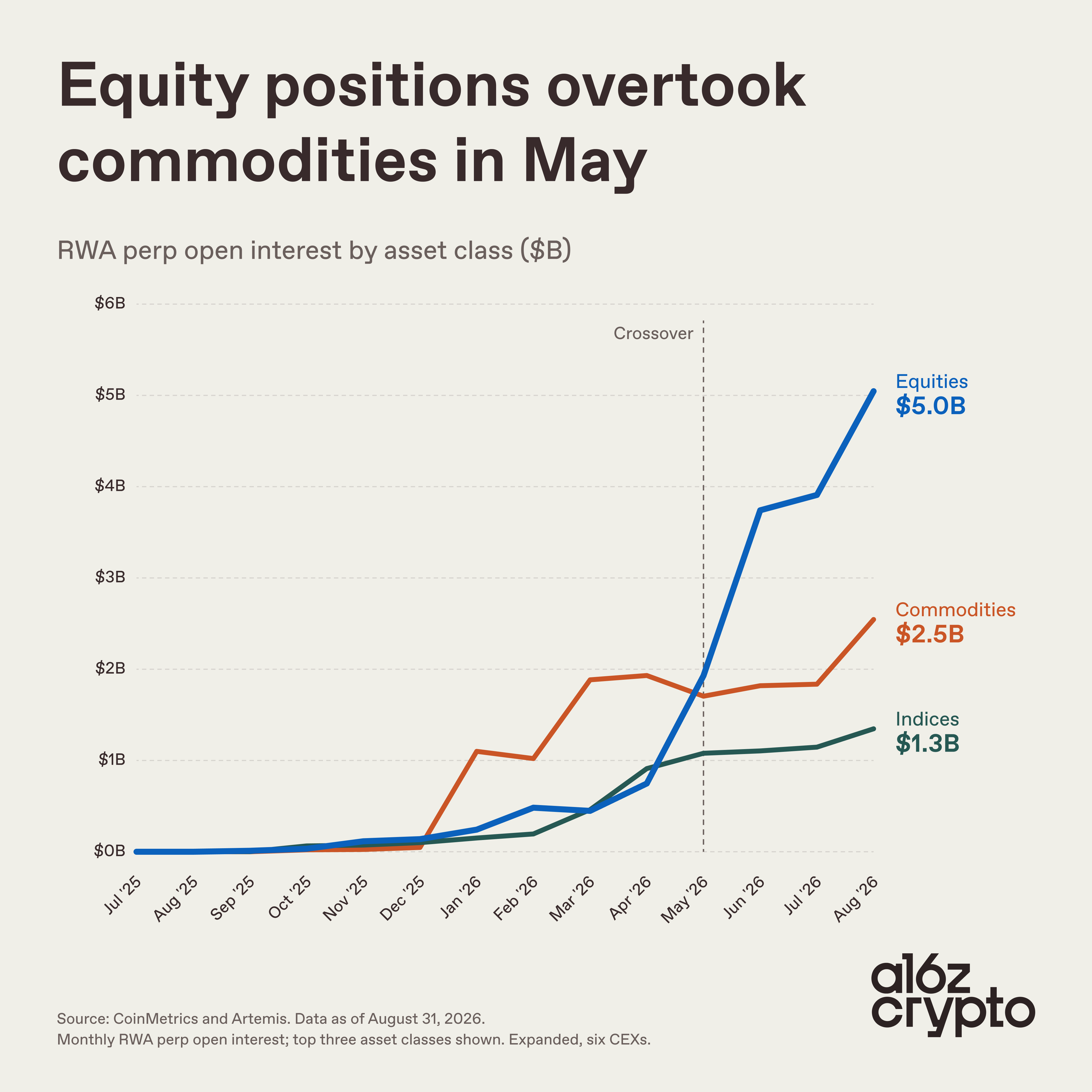
This shift toward equities showed up in open interest before trading volume. Equity open interest passed commodities in May. A month later, equity trading volume passed commodities. The gap in open interest widened through August, with equities at $5.0 billion and commodities at $2.5 billion.
RWA perp trading volume remains small compared with traditional derivatives markets, where futures and options trade in the tens of trillions of dollars per month on long-established platforms.
Yet growth in monthly RWA perp volume shows demand for traditional-market exposure onchain is no longer just a hypothetical. The next question is whether RWA perps become a standard offering at traditional brokers and exchanges.
Acknowledgments: Thanks to data consultant Ryan Holloway for charts and data analysis
The views expressed here are those of the individual AH Capital Management, L.L.C. (“a16z”) personnel quoted and are not the views of a16z or its affiliates. Certain information contained in here has been obtained from third-party sources, including from portfolio companies of funds managed by a16z. While taken from sources believed to be reliable, a16z has not independently verified such information and makes no representations about the current or enduring accuracy of the information or its appropriateness for a given situation. In addition, this content may include third-party advertisements; a16z has not reviewed such advertisements and does not endorse any advertising content contained therein.
This content is provided for informational purposes only, and should not be relied upon as legal, business, investment, or tax advice. You should consult your own advisers as to those matters. References to any securities or digital assets are for illustrative purposes only, and do not constitute an investment recommendation or offer to provide investment advisory services. Furthermore, this content is not directed at nor intended for use by any investors or prospective investors, and may not under any circumstances be relied upon when making a decision to invest in any fund managed by a16z. (An offering to invest in an a16z fund will be made only by the private placement memorandum, subscription agreement, and other relevant documentation of any such fund and should be read in their entirety.) Any investments or portfolio companies mentioned, referred to, or described are not representative of all investments in vehicles managed by a16z, and there can be no assurance that the investments will be profitable or that other investments made in the future will have similar characteristics or results. A list of investments made by funds managed by Andreessen Horowitz (excluding investments for which the issuer has not provided permission for a16z to disclose publicly as well as unannounced investments in publicly traded digital assets) is available at https://a16z.com/investments/.
The content speaks only as of the date indicated. Any projections, estimates, forecasts, targets, prospects, and/or opinions expressed in these materials are subject to change without notice and may differ or be contrary to opinions expressed by others. Please see https://a16z.com/disclosures for additional important information.